The Winter's TaleShakespeare’s First Folio
Scans: Bodleian Libraries, Arch. G c.7.
The First Folio
Bodleian Libraries, University of OxfordThis page image could not load.
This page image could not load.
On the page
Source transcription. Original spelling retained.
Reading The Winter's Tale
Comedies · First Folio, 1623
The Winter's Tale begins with a royal friendship and follows the damage caused when Leontes treats his suspicion as knowledge. Hermione must answer an accusation whose force depends on her husband's authority rather than convincing evidence. The play later changes location, generation, and dramatic mood, but the consequences of that first judgment persist. Its final encounter with an apparently lifeless figure makes looking itself an action with emotional stakes. Read the Folio's directions closely without expecting them to settle everything a performance might show. The difference between hearing a report and witnessing a body matters throughout.
Camillo and Archidamus begin with courteous comparisons of Bohemia and Sicilia. Their conversation presents the kings' friendship as longstanding and sustained across distance. That account gives readers a baseline against which to measure the abrupt change in Leontes's interpretation of the people around him.
Context: The Winter's Tale at the Folger Shakespeare Library. Scans and transcription: Bodleian Libraries, Arch. G c.7.
On the opening page
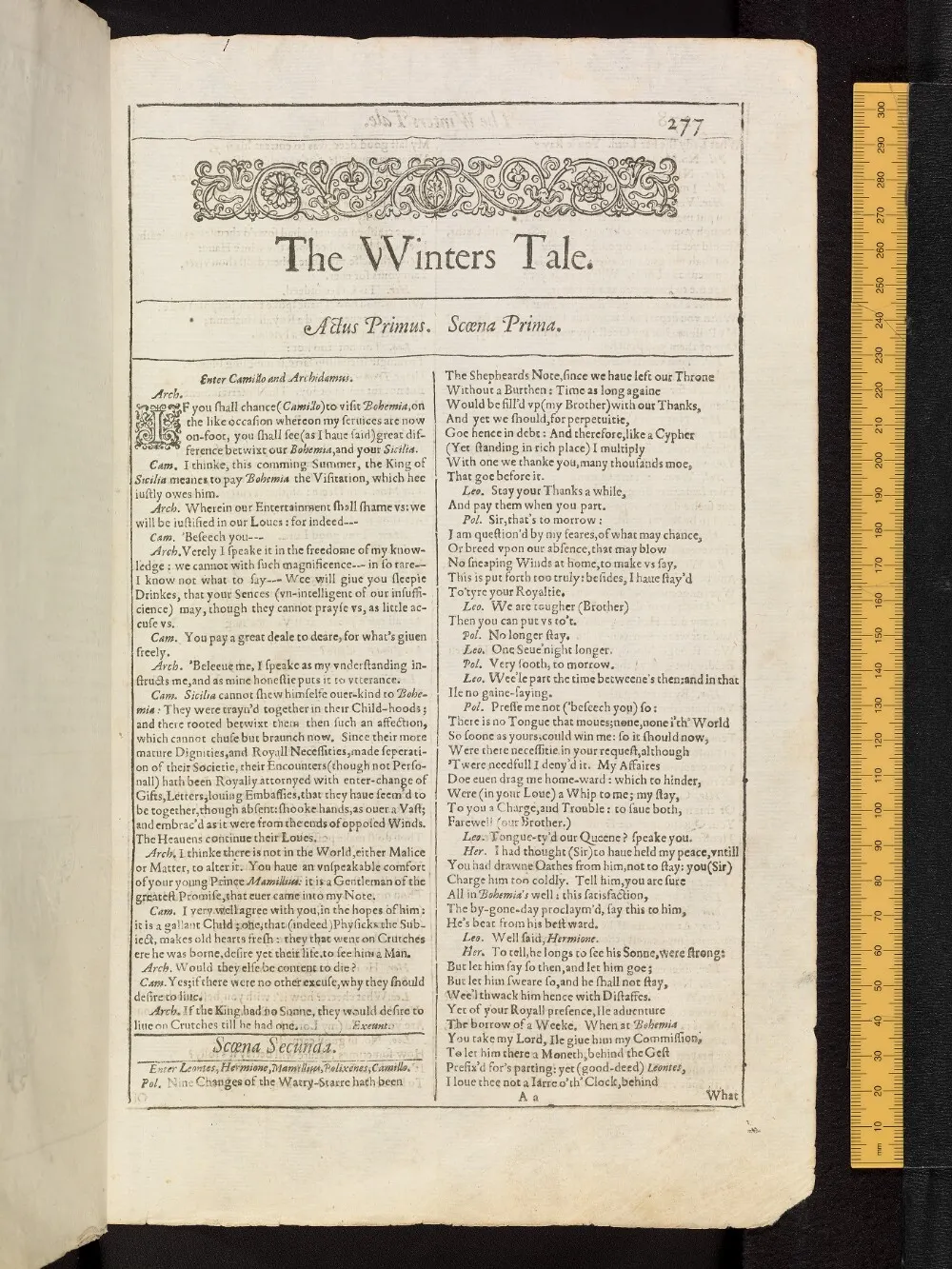
The Winters Tale. Actus Primus. Scœna Prima. [Act 1, Scene 1] Enter Camillo and Archidamus. Arch. IF you shall chance (Camillo) to visit Bohemia, on the like occasion whereon my seruices are now on‑foot, you shall see (as I haue said) great dif ference betwixt our Bohemia, and your Sicilia. Cam. I thinke, this comming Summer, the King of Sicilia meanes to pay Bohemia the Visitation, which hee iustly owes him. Arch. Wherein our Entertainment shall shame vs: we will be iustified in our Loues: for indeed——— Cam. 'Beseech you——— Arch. Verely I speake it in the freedome of my know ledge: we cannot with such magnificence——— in so rare—— I know not what to say——— Wee will giue you sleepie Drinkes, that your Sences (vn‑intelligent of our insuffi cience) may, though they cannot prayse vs, as little ac cuse vs. Cam. You pay a great deale to deare, for what’s giuen freely. Arch. 'Beleeue me, I speake as my vnderstanding in structs me, and as mine honestie puts it to vtterance. Cam. Sicilia cannot shew himselfe ouer‑kind to Bohe mia: They were trayn’d together in their Child‑hoods; and there rooted betwixt them then such an affection, which cannot chuse but braunch now. Since their more mature Dignities, and Royall Necessities, made seperati on of their Societie, their Encounters (though not Perso nall) hath been Royally attornyed with enter‑change of Gifts, Letters, louing Embassies, that they haue seem’d to be together, though absent: shooke hands, as ouer a Vast; and embrac’d as it were from the ends of opposed Winds. The Heauens continue their Loues.
An opening excerpt from the Bodleian transcription, with original spelling retained. Continue in the reader. Text CC BY 3.0.