The Merry Wives of WindsorShakespeare’s First Folio
Scans: Bodleian Libraries, Arch. G c.7.
The First Folio
Bodleian Libraries, University of OxfordThis page image could not load.
This page image could not load.
On the page
Source transcription. Original spelling retained.
Reading The Merry Wives of Windsor
Comedies · First Folio, 1623
The Merry Wives of Windsor brings Falstaff into a town where his confidence in his own desirability makes him vulnerable to other people's planning. Mistress Ford and Mistress Page compare his approaches and turn them into opportunities to expose him. Their shared knowledge matters as much as the physical jokes: the women can cooperate because they speak to one another. Read the Folio's crowded entrances and practical stage directions alongside the dialogue. Laundry, costume, and household space become instruments through which the wives manage what Falstaff and their neighbours think they see.
The play begins with Shallow's grievance against Falstaff, not with the wives' scheme. Shallow and Slender's claims to gentility are immediately tangled in verbal mistakes. The unusually long opening entrance direction is worth comparing with the order in which characters actually speak across the scene.
Context: The Merry Wives of Windsor at the Folger Shakespeare Library. Scans and transcription: Bodleian Libraries, Arch. G c.7.
On the opening page
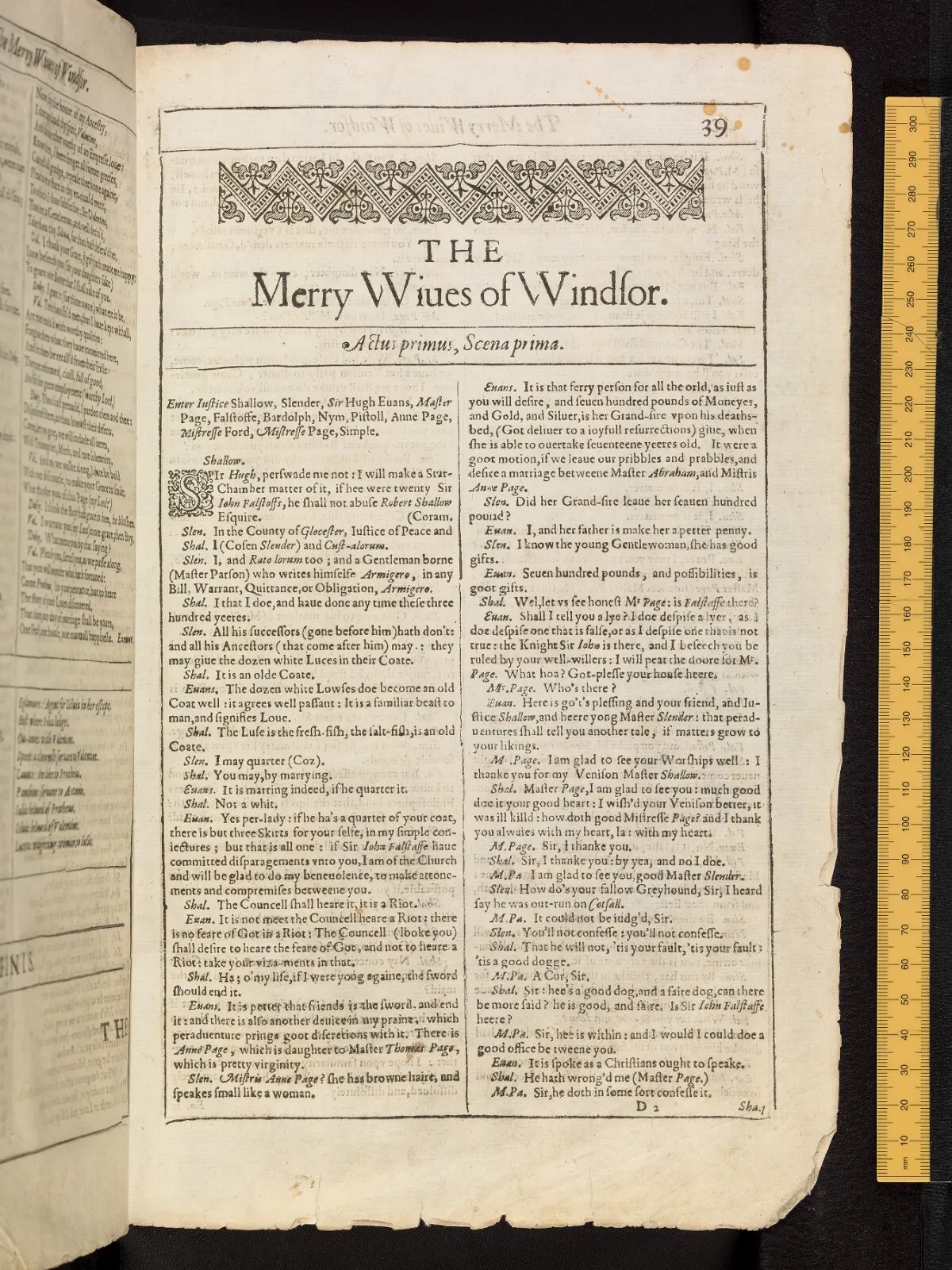
THE Merry Wiues of Windsor. Actus primus, Scena prima. [Act 1, Scene 1] Enter Iustice Shallow, Slender, Sir Hugh Euans, Master Page, Falstoffe, Bardolph, Nym, Pistoll, Anne Page, Mistresse Ford, Mistresse Page, Simple. Shallow. SIr Hugh, perswade me not: I will make a Star‑Chamber matter of it, if hee were twenty Sir Iohn Falstoffs, he shall not abuse Robert Shallow Esquire. Slen. In the County of Glocester, Iustice of Peace and (Coram. Shal. I (Cosen Slender) and Cust‑alorum. Slen. I, and Rato lorum too; and a Gentleman borne (Master Parson) who writes himselfe Armigero, in any Bill, Warrant, Quittance, or Obligation, Armigero. Shal. I that I doe, and haue done any time these three hundred yeeres. Slen. All his successors (gone before him) hath don't: and all his Ancestors (that come after him) may: they may giue the dozen white Luces in their Coate. Shal. It is an olde Coate. Euans. The dozen white Lowses doe become an old Coat well: it agrees well passant: It is a familiar beast to man, and signifies Loue. Shal. The Luse is the fresh‑fish, the salt‑fish, is an old Coate. Slen. I may quarter (Coz). Shal. You may, by marrying. Euans. It is marring indeed, if he quarter it. Shal. Not a whit. Shal. Yes per‑lady: if he ha's a quarter of your coat, there is but three Skirts for your selfe, in my simple con iectures; but that is all one: if Sir Iohn Falstaffe haue committed disparagements vnto you, I am of the Church and will be glad to do my beneuolence, to make attone ments and compremises betweene you. Shal.
An opening excerpt from the Bodleian transcription, with original spelling retained. Continue in the reader. Text CC BY 3.0.