Timon of AthensShakespeare’s First Folio
Scans: Bodleian Libraries, Arch. G c.7.
The First Folio
Bodleian Libraries, University of OxfordThis page image could not load.
This page image could not load.
On the page
Source transcription. Original spelling retained.
Reading Timon of Athens
Tragedies · First Folio, 1623
Timon of Athens follows a generous host whose understanding of friendship depends on other people returning the care he has given them. When his resources fail, the distinction between affection and access to wealth becomes difficult to ignore. His withdrawal from Athens reverses his earlier welcome without resolving the question of what people owe one another. Read the Folio's gifts, invitations, and requests as actions that produce social relationships. A jewel, a meal, or an unpaid obligation can reveal more about a speaker's position than the praise offered in conversation.
The first entrance brings a poet, painter, jeweller, merchant, and mercer toward Timon's household. Their conversation joins praise of the patron with the prospect of reward. The audience can therefore examine the economy surrounding Timon before hearing how he understands his own generosity.
Context: Timon of Athens at the Folger Shakespeare Library. Scans and transcription: Bodleian Libraries, Arch. G c.7.
On the opening page
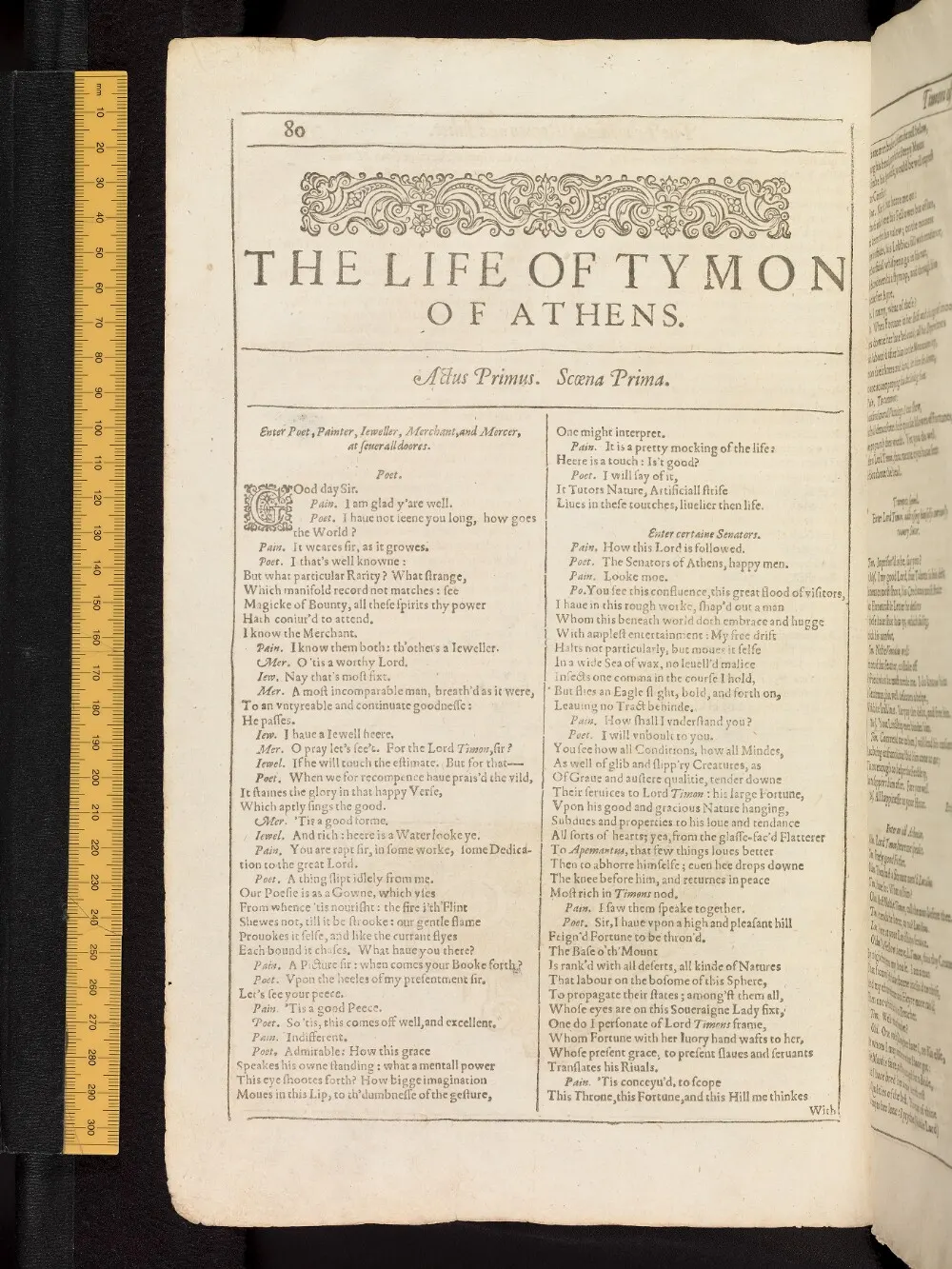
THE LIFE OF TYMON OF ATHENS. Actus Primus. Scœna Prima. [Act 1, Scene 1] Enter Poet, Painter, Ieweller, Merchant, and Mercer, at seuerall doores. Poet. Good day Sir. Pain. I am glad y'are well. Poet. I haue not seene you long, how goes the World? Pain. It weares sir, as it growes. Poet. I that's well knowne: But what particular Rarity? What strange, Which manifold record not matches: see Magicke of Bounty, all these spirits thy power Hath coniur'd to attend. I know the Merchant. Pain. I know them both: th'others a Ieweller. Mer. O 'tis a worthy Lord. Iew. Nay that's most fixt. Mer. A most incomparable man, breath'd as it were, To an vntyreable and continuate goodnesse: He passes. Iew. I haue a Iewell heere. Mer. O pray let's see't. For the Lord Timon, sir? Iewel. If he will touch the estimate. But for that— Poet. When we for recompence haue prais'd the vild, It staines the glory in that happy Verse, Which aptly sings the good. Mer. 'Tis a good forme. Iewel. And rich: heere is a Water looke ye. Pain. You are rapt sir, in some worke, some Dedica tion to the great Lord. Poet. A thing slipt idlely from me. Our Poesie is as a Gowne, which vses From whence 'tis nourisht: the fire i'th'Flint Shewes not, till it be strooke: our gentle flame Prouokes it selfe, and like the currant flyes Each bound it chases. What haue you there? Pain. A Picture sir: when comes your Booke forth? Poet. Vpon the heeles of my presentment sir. Let's see your peece. Pain. 'Tis a good Peece. Poet. So 'tis, this comes off well, and excellent.
An opening excerpt from the Bodleian transcription, with original spelling retained. Continue in the reader. Text CC BY 3.0.