Romeo and JulietShakespeare’s First Folio
Scans: Bodleian Libraries, Arch. G c.7.
The First Folio
Bodleian Libraries, University of OxfordThis page image could not load.
This page image could not load.
On the page
Source transcription. Original spelling retained.
Reading Romeo and Juliet
Tragedies · First Folio, 1623
Romeo and Juliet places a developing relationship inside a city accustomed to conflict between the Capulets and Montagues. The lovers must negotiate inherited names, family expectations, and the practical difficulty of finding private time. Messages and timing matter because the knowledge available to one character may not reach another soon enough. Reading the First Folio also makes differences between editions visible. This text begins directly with the Capulet servants rather than the familiar opening sonnet, directing immediate attention to the verbal aggression through which the feud enters ordinary street life.
Sampson and Gregory enter with swords and bucklers. Their puns turn quickly toward threats against the Montagues, so language and the possibility of physical violence arrive together. Compare that opening with a modern edition if its prologue is familiar: the Folio's first encounter with Verona has a different shape.
Context: Romeo and Juliet at the Folger Shakespeare Library. Scans and transcription: Bodleian Libraries, Arch. G c.7.
On the opening page
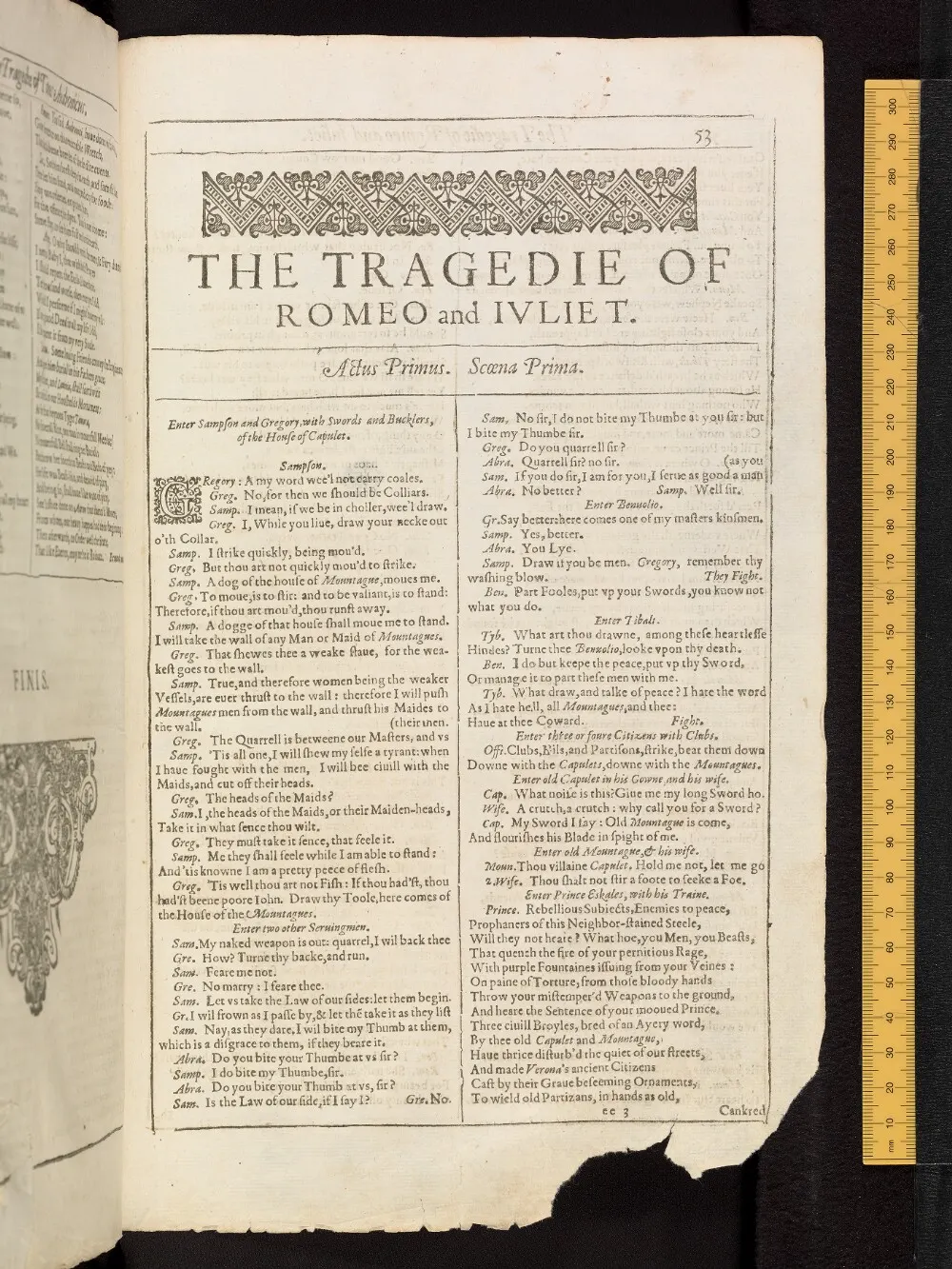
THE TRAGEDIE OF ROMEO and IVLIET. Actus Primus. Scœna Prima. [Act 1, Scene 1] Enter Sampson and Gregory, with Swords and Bucklers, of the House of Capulet. Sampson. G Regory: A my word wee'l not carry coales. Greg. No, for then we should be Colliars. Samp. I mean, if we be in choller, wee'l draw. Greg. I, While you liue, draw your necke out o'th Collar. Samp. I strike quickly, being mou'd. Greg. But thou art not quickly mou'd to strike. Samp. A dog of the house of Mountague, moues me. Greg. To moue, is to stir: and to be valiant, is to stand: Therefore, if thou art mou'd, thou runst away. Samp. A dogge of that house shall moue me to stand. I will take the wall of any Man or Maid of Mountagues. Greg. That shewes thee a weake slaue, for the wea kest goes to the wall. Samp. True, and therefore women being the weaker Vessels, are euer thrust to the wall: therefore I will push Mountagues men from the wall, and thrust his Maides to the wall. Greg. The Quarrell is betweene our Masters, and vs (their men. Samp. 'Tis all one, I will shew my selfe a tyrant: when I haue fought with the men, I will bee ciuill with the Maids, and cut off their heads. Greg. The heads of the Maids? Sam. I, the heads of the Maids, or their Maiden‑heads, Take it in what sence thou wilt. Greg. They must take it sence, that feele it. Samp. Me they shall feele while I am able to stand: And 'tis knowne I am a pretty peece of flesh. Greg. 'Tis well thou art not Fish: If thou had'st, thou had'st beene poore Iohn. Draw thy Toole, here comes of the House of the Mountagues.
An opening excerpt from the Bodleian transcription, with original spelling retained. Continue in the reader. Text CC BY 3.0.