OthelloShakespeare’s First Folio
Scans: Bodleian Libraries, Arch. G c.7.
The First Folio
Bodleian Libraries, University of OxfordThis page image could not load.
This page image could not load.
On the page
Source transcription. Original spelling retained.
Reading Othello
Tragedies · First Folio, 1623
Othello follows the destruction of a marriage through claims that persuade Othello to distrust Desdemona. Iago manages encounters and interpretations, making other people's speech and conduct appear to confirm his insinuations. The handkerchief matters because an object can be made to carry a story its owner did not intend. Read the Folio with attention to the gap between seeing something and knowing what it means. The play's racial hostility and gendered accusations shape whose account receives a hearing, making credibility a question of power as well as of evidence.
Roderigo and Iago enter in the middle of a disagreement. Before Othello appears, Iago explains his resentment over Cassio's promotion and offers an account of the general to another listener. The audience's first information is therefore delivered by a speaker with an interest in directing its judgment.
Context: Othello at the Folger Shakespeare Library. Scans and transcription: Bodleian Libraries, Arch. G c.7.
On the opening page
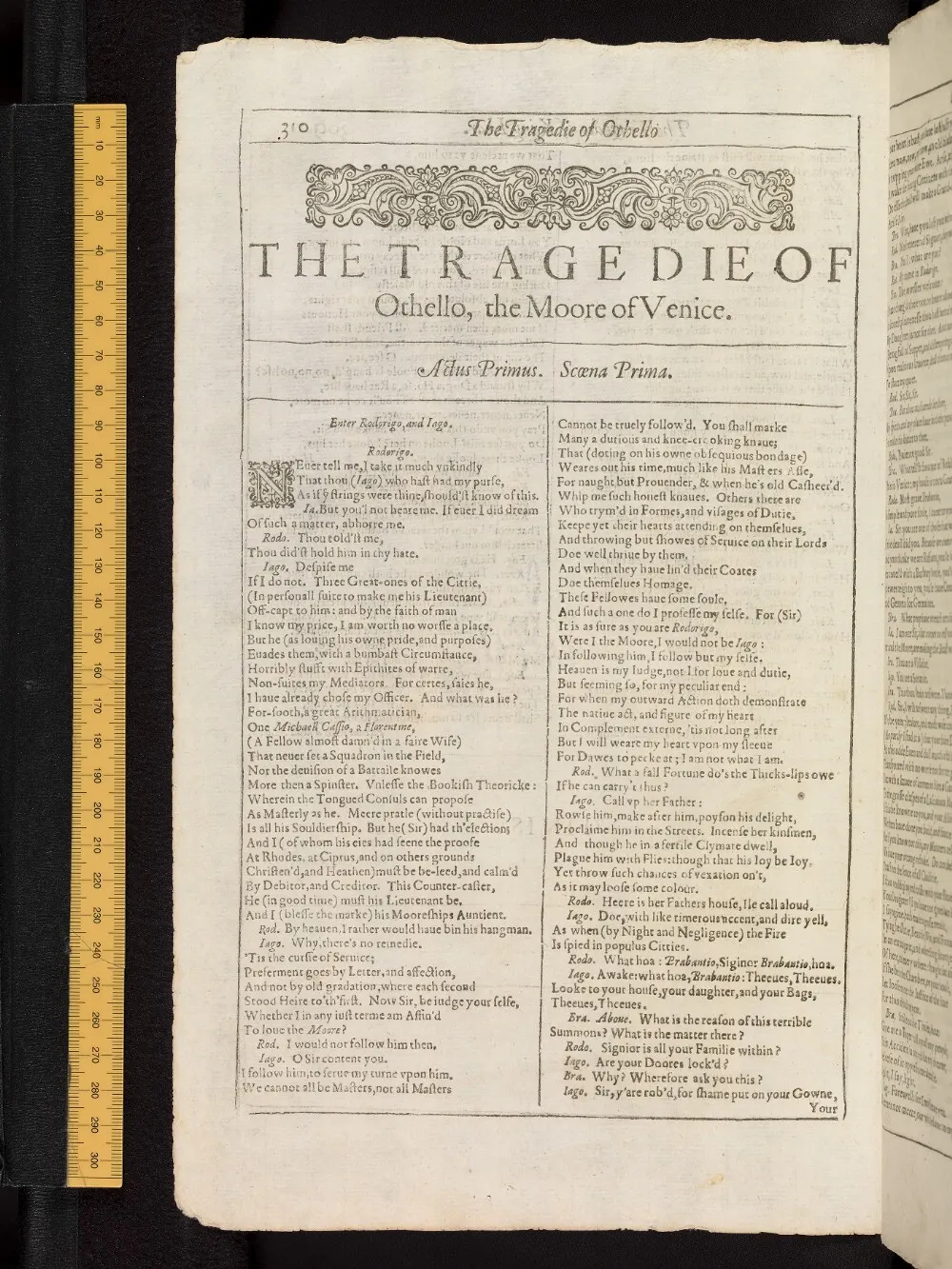
THE TRAGEDIE OF
Othello, the Moore of Venice.

Actus Primus. Scœna Prima.

[Act 1, Scene 1]

Enter Rodorigo, and Iago.

Rodorigo.

NEuer tell me, I take it much vnkindly

That thou (Iago) who hast had my purse,

As if yͤ strings were thine, should'st know of this.

Ia.

But you'l not heare me. If euer I did dream

Of such a matter, abhorre me.

Rodo.

Thou told'st me,

Thou did'st hold him in thy hate.

Iago.

Despise me

If I do not. Three Great‑ones of the Cittie,

(In personall suite to make me his Lieutenant)

Off‑capt to him: and by the faith of man

I know my price, I am worth no worsse a place.

But he (as louing his owne pride, and purposes)

Euades them, with a bumbast Circumstance,

Horribly stufft with Epithites of warre,

Non‑suites my Mediators. For certes, saies he,

I haue already chose my Officer. And what was he?

For‑sooth, a great Arithmatician,

One Michaell Cassio, a Florentine,

(A Fellow almost damn'd in a faire Wife)

That neuer set a Squadron in the Field,

Nor the deuision of a Battaile knows

More then a Spinster. Vnlesse the Bookish Theoricke:

Wherein the Tongued Consuls can propose

As Masterly as he. Meere pratle (without practise)

Is all his Souldiership. But he (Sir) had th'election;

And I (of whom his eies had seene the proofe

At Rhodes, at Ciprus, and on others grounds

Christen'd, and Heathen) must be be‑leed, and calm'd

By Debitor, and Creditor. This Counter‑caster,

He (in good time) must his Lieutenant be.

And I (blesse the marke) his Mooreships Auntient.

Rod.

By heauen, I rather would haue bin his hangman.

Iago.
An opening excerpt from the Bodleian transcription, with original spelling retained. Continue in the reader. Text CC BY 3.0.