Much Ado About NothingShakespeare’s First Folio
Scans: Bodleian Libraries, Arch. G c.7.
The First Folio
Bodleian Libraries, University of OxfordThis page image could not load.
This page image could not load.
On the page
Source transcription. Original spelling retained.
Reading Much Ado About Nothing
Comedies · First Folio, 1623
Much Ado About Nothing places Beatrice and Benedick's verbal contests beside the courtship of Hero and Claudio. Both relationships are shaped by what people hear about others, but the consequences of believing a report are sharply unequal. The same social world that can arrange a happy deception can also make a woman's reputation vulnerable to a public accusation. Reading the Folio invites attention to messengers, listeners, and staged encounters as parts of the action. Ask what counts as evidence in each scene, who presents it, and how readily the other characters accept the story they are offered.
Leonato receives news of returning soldiers in the opening scene. The messenger's account of Claudio establishes a reputation before Claudio speaks for himself; Beatrice's questions then introduce a different way of assessing Benedick. The scene begins the play's sustained interest in knowing people through reports.
Context: Much Ado About Nothing at the Folger Shakespeare Library. Scans and transcription: Bodleian Libraries, Arch. G c.7.
On the opening page
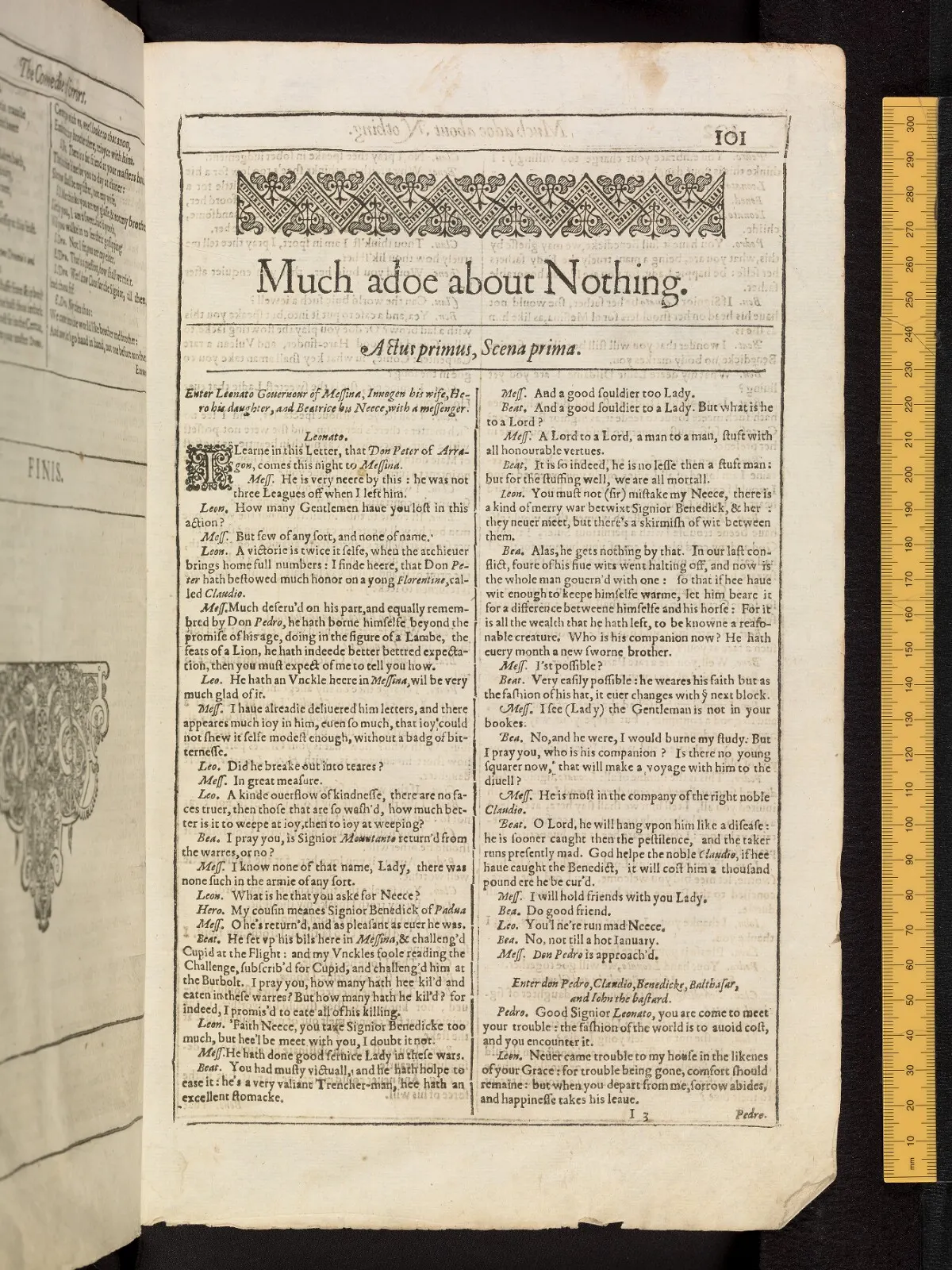
Much adoe about Nothing. Actus primus, Scena prima. [Act 1, Scene 1] Enter Leonato Gouernour of Messina, Innogen his wife, He ro his daughter, and Beatrice his Neece, with a messenger. Leonato. I Learne in this Letter, that Don Peter of Arra gon, comes this night to Messina. Mess. He is very neere by this: he was not three Leagues off when I left him. Leon. How many Gentlemen haue you lost in this action? Mess. But few of any sort, and none of name. Leon. A victorie is twice it selfe, when the atchieuer brings home full numbers: I finde heere, that Don Pe ter hath bestowed much honor on a yong Florentine, cal led Claudio. Mess. Much deseru'd on his part, and equally remem bred by Don Pedro, he hath borne himselfe beyond the promise of his age, doing in the figure of a Lambe, the feats of a Lion, he hath indeede better bettred expecta tion, then you must expect of me to tell you how. Leo. He hath an Vnckle heere in Messina, wil be very much glad of it. Mess. I haue alreadie deliuered him letters, and there appeares much ioy in him, euen so much, that ioy could not shew it selfe modest enough, without a badg of bit ternesse. Leo. Did he breake out into teares? Mess. In great measure. Leo. A kinde ouerflow of kindnesse, there are no fa ces truer, then those that are so wash'd, how much bet ter is it to weepe at ioy, then to ioy at weeping? Bea. I pray you, is Signior Mountanto return'd from the warres, or no? Mess. I know none of that name, Lady, there was none such in the armie of any sort. Leon. What is he that you aske for Neece?
An opening excerpt from the Bodleian transcription, with original spelling retained. Continue in the reader. Text CC BY 3.0.