The Merchant of VeniceShakespeare’s First Folio
Scans: Bodleian Libraries, Arch. G c.7.
The First Folio
Bodleian Libraries, University of OxfordThis page image could not load.
This page image could not load.
On the page
Source transcription. Original spelling retained.
Reading The Merchant of Venice
Comedies · First Folio, 1623
The Merchant of Venice makes promises binding in very different ways. Bassanio seeks Portia through a test established by her father's will, while Antonio's agreement with Shylock turns a financial obligation into a threat against his body. The play's hostility toward its Jewish character requires careful reading, especially when the Christian characters claim the language of mercy. Attend to who can interpret a rule and who must submit to that interpretation. The Folio preserves a comedy whose marriages coexist with punishment and dispossession, making the terms of its resolution part of the reader's work.
Antonio begins by admitting that he cannot explain his sadness. His companions try to locate its cause in commercial risk, imagining ships and hazards at sea. The exchange connects feeling to financial investment before the bond with Shylock gives that connection a precise and dangerous form.
Context: The Merchant of Venice at the Folger Shakespeare Library. Scans and transcription: Bodleian Libraries, Arch. G c.7.
On the opening page
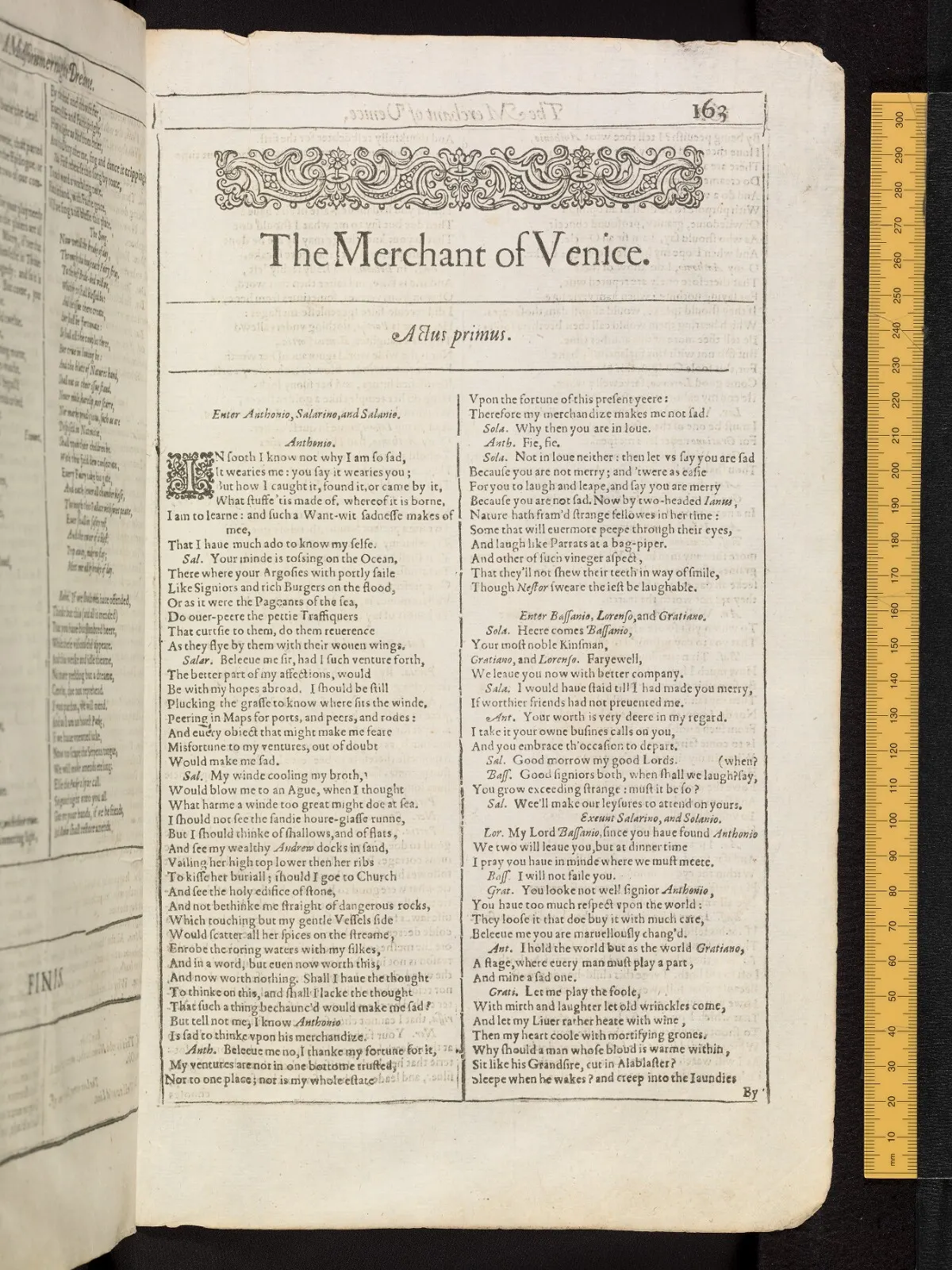
The Merchant of Venice.

Actus primus.

[Act 1, Scene 1]

Enter Anthonio, Salarino, and Salanio.

Anthonio.

IN sooth I know not why I am so sad,

It wearies me: you say it wearies you;

But how I caught it, found it, or came by it,

What stuffe 'tis made of, whereof it is borne,

I am to learne: and such a Want‑wit sadnesse makes of
mee,

That I haue much ado to know my selfe.

Sal.

Your minde is tossing on the Ocean,

There where your Argosies with portly saile

Like Signiors and rich Burgers on the flood,

Or as it were the Pag[gap]ants of the sea,

Do ouer‑peere the pettie Traffiquers

That curtsie to them, do them reuerence

As they flye by them with their wouen wings.

Salar.

Beleeue me sir, had I such venture forth,

The better part of my affections, would

Be with my hopes abroad. I should be still

Plucking the grasse to know where sits the winde.

Peering in Maps for ports, and peers, and rodes:

And euery obiect that might make me feare

Misfortune to my ventures, out of doubt

Would make me sad.

Sal.

My winde cooling my broth,

Would blow me to an Ague, when I thought

What harme a winde too great might doe at sea.

I should not see the sandie houre‑glasse runne,

But I should thinke of shallows, and of flats,

And see my wealthy Andrew docks in sand,

Vailing her high top lower then her ribs

To kisse her buriall; should I goe to Church

And see the holy edifice of stone,

And not bethinke me straight of dangerous rocks,

Which touching but my gentle Vessels side

Would scatter all her spices on the streame,

Enrobe the roring waters with my silkes,
An opening excerpt from the Bodleian transcription, with original spelling retained. Continue in the reader. Text CC BY 3.0.