MacbethShakespeare’s First Folio
Scans: Bodleian Libraries, Arch. G c.7.
The First Folio
Bodleian Libraries, University of OxfordThis page image could not load.
This page image could not load.
On the page
Source transcription. Original spelling retained.
Reading Macbeth
Tragedies · First Folio, 1623
Macbeth follows a soldier who begins to treat a promised future as something he must bring about himself. The witches' language offers possibilities that Macbeth and Lady Macbeth interpret and act upon, but gaining the crown does not settle their relation to fear. Bodies, sounds, and imagined sights repeatedly interrupt attempts to manage appearances. Reading the Folio gives particular force to the practical work of the theatre: a report of battle, a knock at a door, or a figure visible to only one character can change what an audience understands. Follow who can see and hear each disturbance.
Thunder and lightning accompany the witches' first entrance. Their brief meeting is followed on the same opening page by the arrival of a bleeding captain whose report introduces Macbeth's military reputation. The reader encounters both prediction and bodily evidence before meeting the man they concern.
Context: Macbeth at the Folger Shakespeare Library. Scans and transcription: Bodleian Libraries, Arch. G c.7.
On the opening page
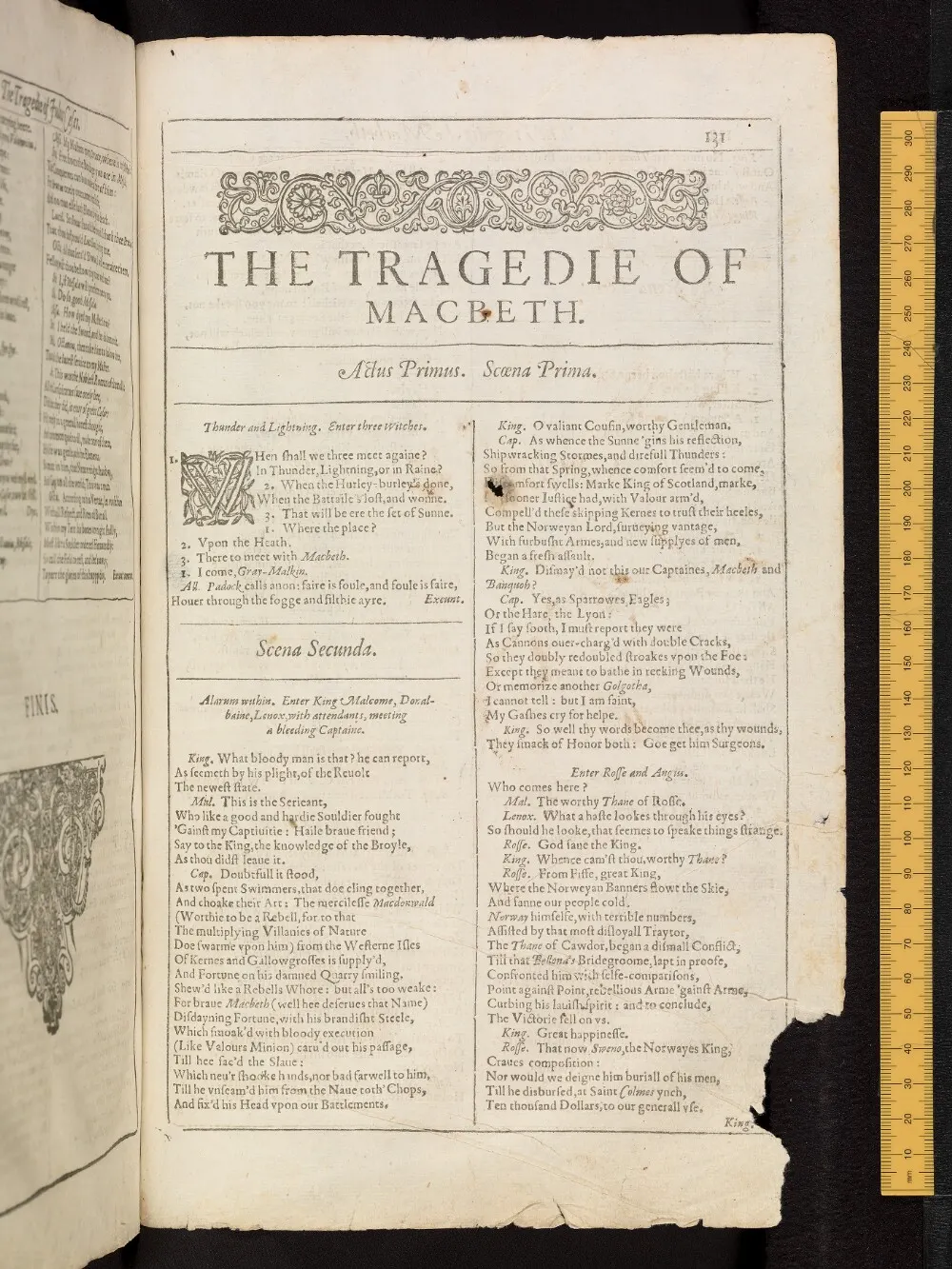
THE TRAGEDIE OF MACBETH. Actus Primus. Scœna Prima. [Act 1, Scene 1] Thunder and Lightning. Enter three Witches. 1. When shall we three meet againe? In Thunder, Lightning, or in Raine? 2. When the Hurley‑burley's done, When the Battaile's lost, and wonne. 3. That will be ere the set of Sunne. 1. Where the place? 2. Vpon the Heath. 3. There to meet with Macbeth. 1. I come, Gray‑Malkin. All. Padock calls anon: faire is foule, and foule is faire, Houer through the fogge and filthie ayre. Exeunt. Scena Secunda. [Act 1, Scene 2] Alarum within. Enter King Malcome, Donal baine, Lenox, with attendants, meeting a bleeding Captaine. King. What bloody man is that? he can report, As seemeth by his plight, of the Reuolt The newest state Mal. This is the Serieant, Who like a good and hardie Souldier fought 'Gainst my Captiuitie: Haile braue friend; Say to the King, the knowledge of the Broyle, As thou didst leaue it. Cap. Doubtfull it stood, As two spent Swimmers, that doe cling together, And choake their Art: The mercilesse Macdonwald (Worthie to be a Rebell, for to that The multiplying Villanies of Nature Doe swarme vpon him) from the Westerne Isles Of Kernes and Gallowgrosses is supply'd, And Fortune on his damned Quarry smiling, Shew'd like a Rebells Whore: but all's too weake: For braue Macbeth (well hee deserues that Name) Disdayning Fortune, with his brandisht Steele, Which smoak'd with bloody execution (Like Valours Minion) caru'd out his passage, Till hee fac'd the Slaue: Which neu'r shooke hands, nor bad farwell to him,
An opening excerpt from the Bodleian transcription, with original spelling retained. Continue in the reader. Text CC BY 3.0.