King LearShakespeare’s First Folio
Scans: Bodleian Libraries, Arch. G c.7.
The First Folio
Bodleian Libraries, University of OxfordThis page image could not load.
This page image could not load.
On the page
Source transcription. Original spelling retained.
Reading King Lear
Tragedies · First Folio, 1623
King Lear begins with the distribution of a kingdom and turns that public act into a crisis within two families. Lear and Gloucester misread the children around them, while the consequences of their judgments expose bodies to displacement and violence. The play asks what recognition can accomplish when it arrives after an injury. Reading the First Folio means encountering a specific early text of King Lear, not every passage found in modern editions. Attend to the sequence of voices, entrances, and acts of care through which people try to understand one another after familiar forms of authority have failed.
Kent and Gloucester first discuss the proposed division of the kingdom. Gloucester then introduces Edmund in terms that make the circumstances of his birth public conversation. Before Lear stages his daughters' declarations, the opening has already connected family recognition with unequal standing and inherited power.
Context: King Lear at the Folger Shakespeare Library. Scans and transcription: Bodleian Libraries, Arch. G c.7.
On the opening page
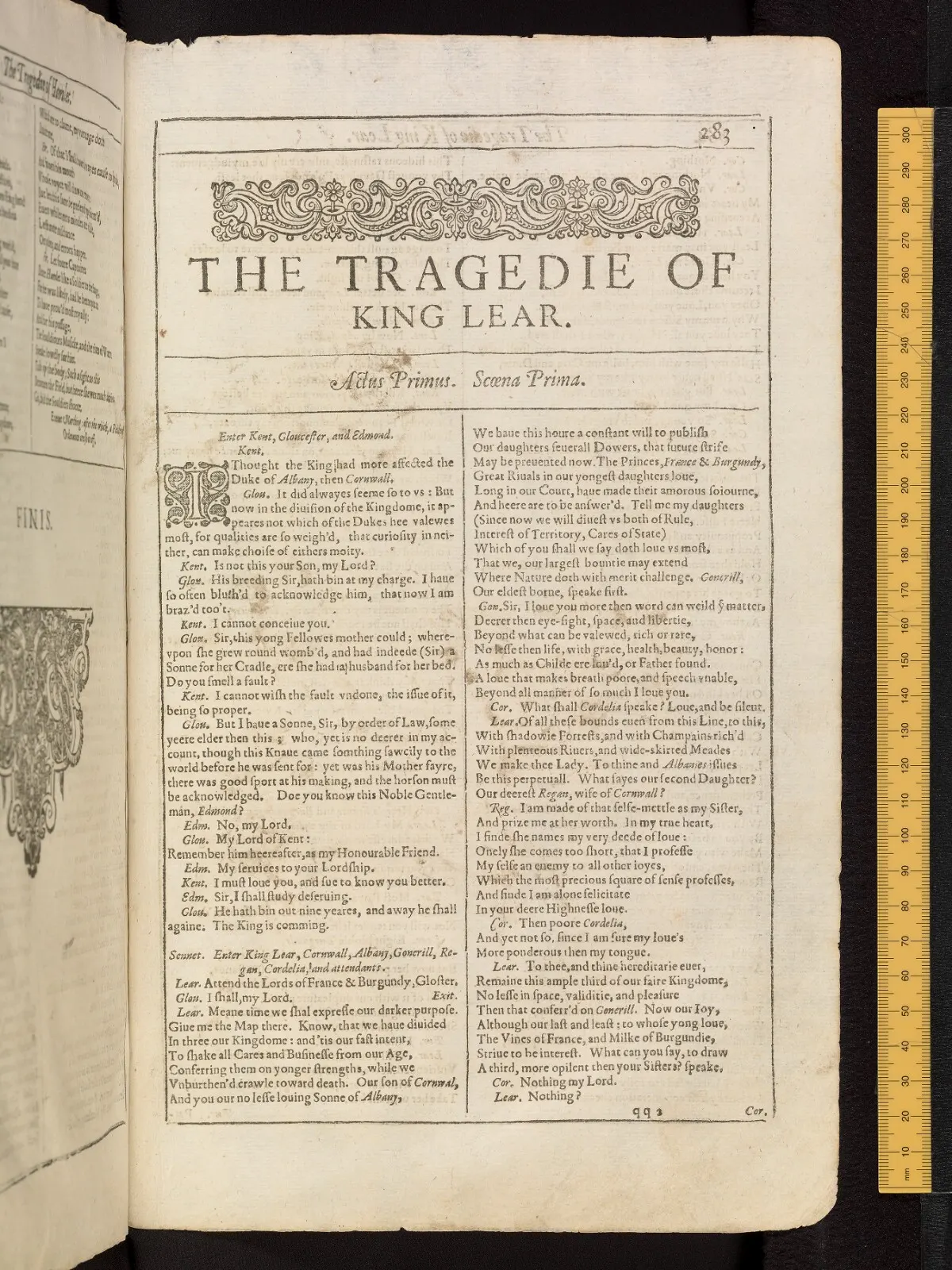
The Tragedie of King Lear. Actus Primus. Scœna Prima. [Act 1, Scene 1] Enter Kent, Gloucester, and Edmond. Kent. I Thought the King had more affected the Duke of Albany, then Cornwall. Glou. It did alwayes seeme so to vs: But now in the diuision of the Kingdome, it ap peares not which of the Dukes hee valewes most, for qualities are so weigh'd, that curiosity in nei ther, can make choise of eithers moity. Kent. Is not this your Son, my Lord? Glou. His breeding Sir, hath bin at my charge. I haue so often blush'd to acknowledge him, that now I am braz'd too't. Kent. I cannot conceiue you. Glou. Sir, this yong Fellowes mother could; wherevpon she grew round womb'd, and had indeede (Sir) a Sonne for her Cradle, ere she had [gap] husband for her bed. Do you smell a fault? Kent. I cannot wish the fault vndone, the issue of it, being so proper. Glou. But I haue a Sonne, Sir, by order of Law, some yeere elder then this; who, yet is no deerer in my account, though this Knaue came somthing sawcily to the world before he was sent for: yet was his Mother fayre, there was good sport at his making, and the horson must be acknowledged. Doe you know this Noble Gentleman, Edmond? Edm. No, my Lord. Glou. My Lord of Kent: Remember him heereafter, as my Honourable Friend. Edm. My seruices to your Lordship. Kent. I must loue you, and sue to know you better. Edm. Sir, I shall study deseruing. Glou. He hath bin out nine yeares, and away he shall againe. The King is comming. Sennet. Enter King Lear, Cornwall, Albany, Gonerill, Re
An opening excerpt from the Bodleian transcription, with original spelling retained. Continue in the reader. Text CC BY 3.0.