Julius CaesarShakespeare’s First Folio
Scans: Bodleian Libraries, Arch. G c.7.
The First Folio
Bodleian Libraries, University of OxfordThis page image could not load.
This page image could not load.
On the page
Source transcription. Original spelling retained.
Reading Julius Caesar
Tragedies · First Folio, 1623
Julius Caesar dramatises an assassination whose justification remains contested by those who perform it and those who survive it. Brutus attempts to distinguish public duty from personal hostility, but the murder does not give him control over its meaning. Speeches, bodies, and the responses of a crowd become means of deciding what Rome has witnessed. In the Folio, follow how an audience is formed inside the play. The citizens are not merely present for public events; their reactions help determine what political action can follow from an account of those events.
The play opens with tribunes confronting working people in the street. Questions about clothing and occupation become an argument over why the citizens are celebrating. Caesar's public standing is therefore introduced through a dispute about spectators and allegiance before Caesar himself enters the action.
Context: Julius Caesar at the Folger Shakespeare Library. Scans and transcription: Bodleian Libraries, Arch. G c.7.
On the opening page
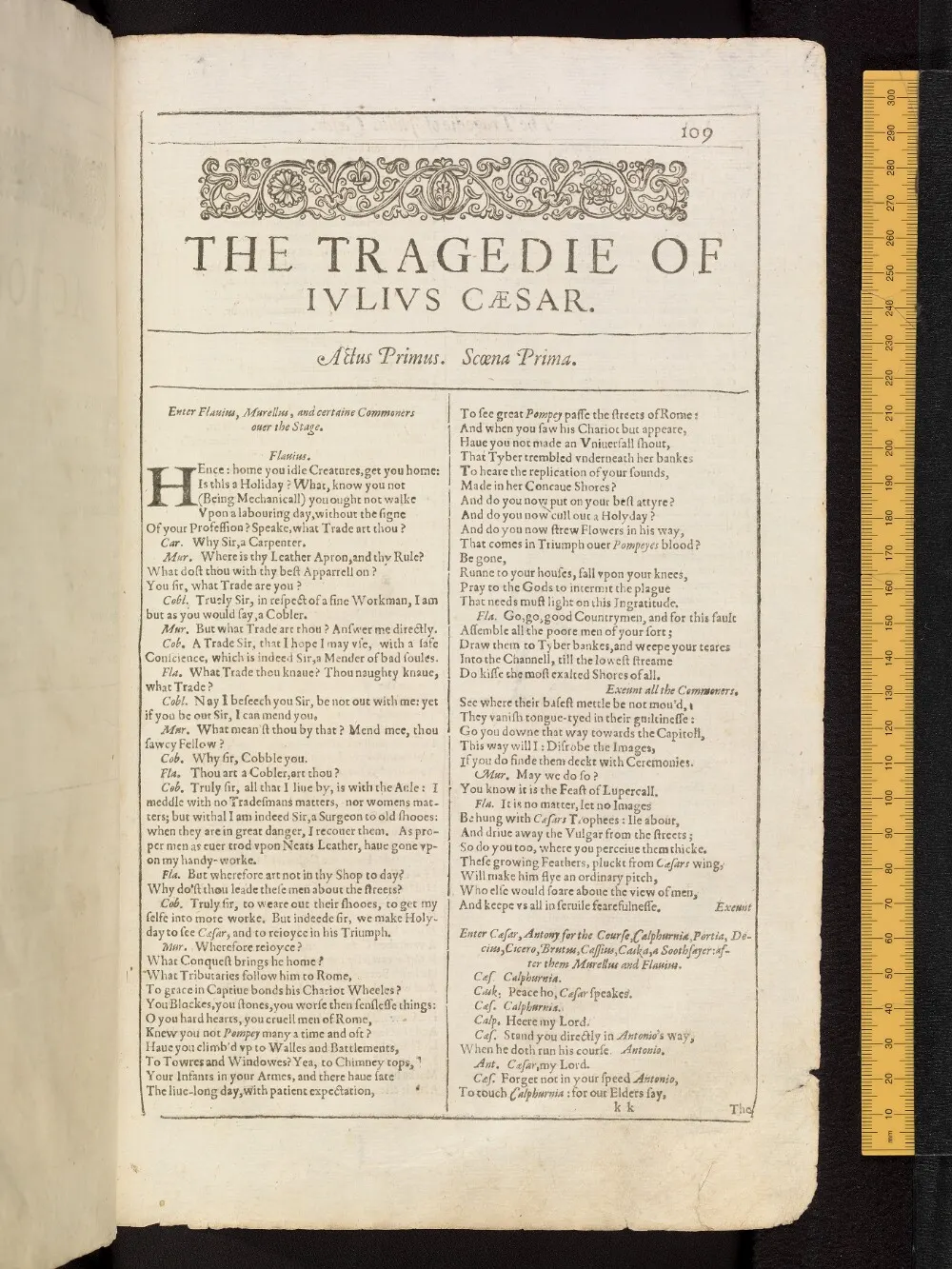
THE TRAGEDIE OF IVLIVS CæSAR Actus Primus. Scœna Prima. [Act 1, Scene 1] Enter Flauius, Murellus, and certaine Commoners ouer the Stage. Flauius. HEnce: home you idle Creatures, get you home: Is this a Holiday? What, know you not (Being Mechanicall) you ought not walke Vpon a labouring day, without the signe Of your Profession? Speake, what Trade art thou? Car. Why Sir, a Carpenter. Mur. Where is thy Leather Apron, and thy Rule? What dost thou with thy best Apparrell on? You sir, what Trade are you? Cobl. Truely Sir, in respect of a fine Workman, I am but as you would say, a Cobler. Mur. But what Trade art thou? Answer me directly. Cob. A Trade Sir, that I hope I may vse, with a safe Conscience, which is indeed Sir, a Mender of bad soules. Fla. What Trade thou knaue? Thou naughty knaue, what Trade? Cobl. Nay I beseech you Sir, be not out with me: yet if you be out Sir, I can mend you. Mur. What mean'st thou by that? Mend mee, thou sawcy Fellow? Cob. Why sir, Cobble you. Fla. Thou art a Cobler, art thou? Cob. Truly sir, all that I liue by, is with the Aule: I meddle with no Tradesmans matters, nor womens mat ters; but withal I am indeed Sir, a Surgeon to old shooes: when they are in great danger, I recouer them. As pro per men as euer trod vpon Neats Leather, haue gone vp on my handy‑worke. Fla. But wherefore art not in thy Shop to day? Why do'st thou leade these men about the streets? Cob. Truly sir, to weare out their shooes, to get my selfe into more worke. But indeede sir, we make Holy
An opening excerpt from the Bodleian transcription, with original spelling retained. Continue in the reader. Text CC BY 3.0.