CymbelineShakespeare’s First Folio
Scans: Bodleian Libraries, Arch. G c.7.
The First Folio
Bodleian Libraries, University of OxfordThis page image could not load.
This page image could not load.
On the page
Source transcription. Original spelling retained.
Reading Cymbeline
Tragedies · First Folio, 1623
Cymbeline brings a secret marriage into conflict with a king's plans for his daughter. Imogen's separation from Posthumus exposes her to a false account of her conduct, while disguise and mistaken recognition draw her into another household. The play's movements between court, Italy, and Wales make knowledge dependent on travel and report. Read its Folio title and position among the tragedies alongside the reunions that develop toward its close. That tension is a useful reminder that the categories in the printed collection are part of its history rather than instructions that determine every reader's experience.
Two gentlemen begin by explaining the court's unhappiness and Imogen's marriage. One distinguishes the courtiers' outward expressions from their private satisfaction, making performed feeling an immediate problem. The opening asks the reader to imagine a court whose faces follow the King even when its loyalties do not.
Context: Cymbeline at the Folger Shakespeare Library. Scans and transcription: Bodleian Libraries, Arch. G c.7.
On the opening page
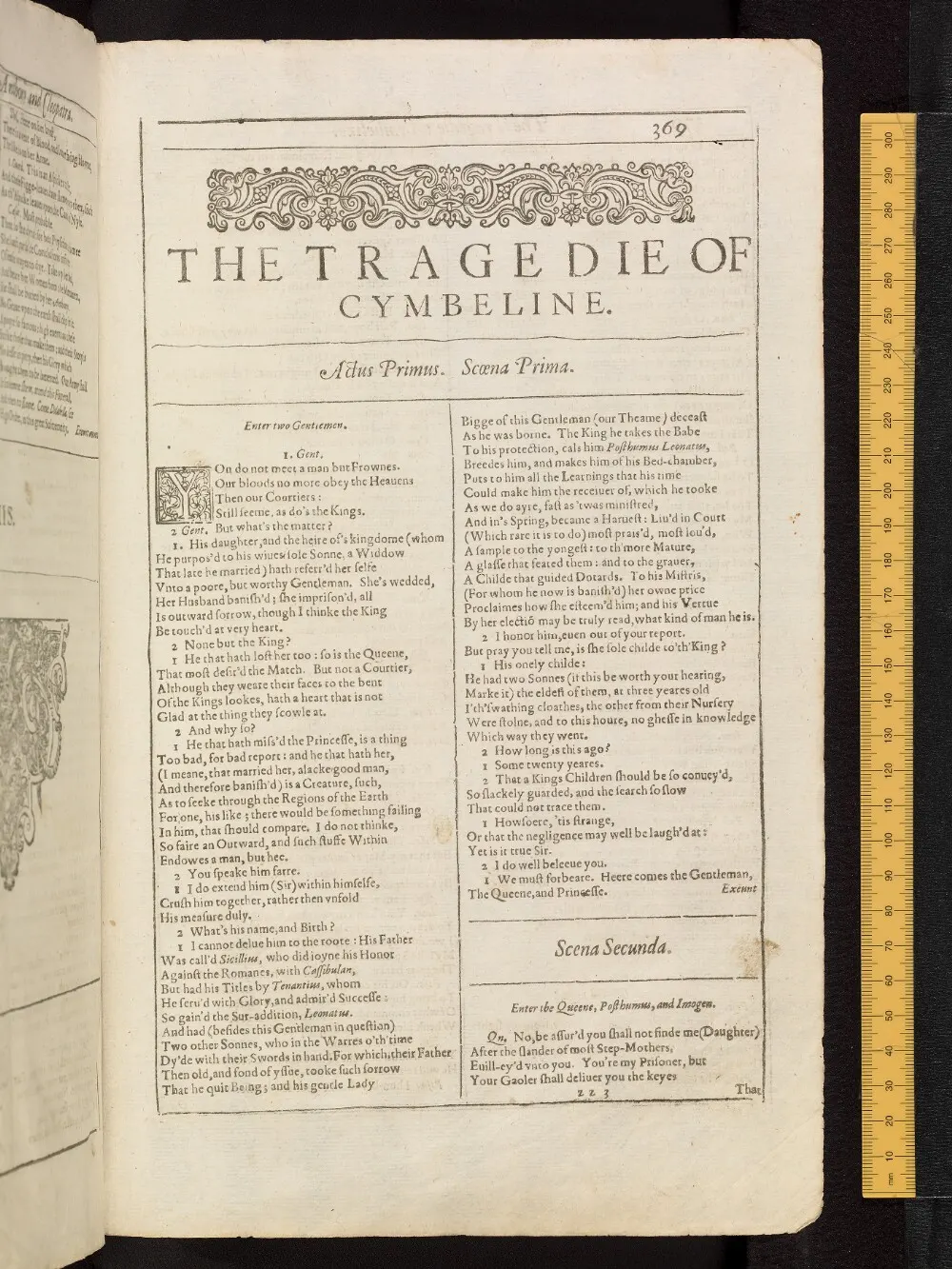
THE TRAGEDIE OF
CYMBELINE.

Actus Primus. Scœna Prima.

[Act 1, Scene 1]

Enter two Gentlemen.

1. Gent.

YOu do not meet a man but Frownes.

Our bloods no more obey the Heauens

Then our Courtiers:

Still seeme, as do's the Kings.

2 Gent.

But what's the matter?

1.

His daughter, and the heire of's kingdome (whom

He purpos'd to his wiues sole Sonne, a Widdow

That late he married) hath referr'd her selfe

Vnto a poore, but worthy Gentleman. She's wedded,

Her Husband banish'd; she imprison'd, all

Is outward sorrow, though I thinke the King

Be touch'd at very heart.

2

None but the King?

1

He that hath lost her too: so is the Queene,

That most desir'd the Match. But not a Courtier,

Although they weare their faces to the bent

Of the Kings lookes, hath a heart that is not

Glad at the thing they scowle at.

2

And why so?

1

He that hath miss'd the Princesse, is a thing

Too bad, for bad report: and he that hath her,

(I meane, that married her, alacke good man,

And therefore banish'd) is a Creature, such,

As to seeke through the Regions of the Earth

For one, his like; there would be something failing

In him, that should compare. I do not thinke,

So faire an Outward, and such stuffe Within

Endowes a man, but hee.

2

You speake him farre.

1

I do extend him (Sir) within himselfe,

Crush him together, rather then vnfold

His measure duly.

2

What's his name, and Birth?

1

I cannot delue him to the roote: His Father

Was call'd Sicillius, who did ioyne his Honor

Against the Romanes, with Cassibulan,

But had his Titles by Tenantius, whom
An opening excerpt from the Bodleian transcription, with original spelling retained. Continue in the reader. Text CC BY 3.0.