As You Like ItShakespeare’s First Folio
Scans: Bodleian Libraries, Arch. G c.7.
The First Folio
Bodleian Libraries, University of OxfordThis page image could not load.
This page image could not load.
On the page
Source transcription. Original spelling retained.
Reading As You Like It
Comedies · First Folio, 1623
As You Like It begins with households and a court that have become unsafe for younger relatives. In the Forest of Arden, displaced characters find new company and new opportunities to test how they present themselves. Rosalind's disguise as Ganymede lets her direct an unusual courtship in which Orlando rehearses speaking to the woman he loves without recognising her. Read those scenes as performances with unequal knowledge. The Folio's dialogue allows readers to distinguish what Orlando thinks the encounter means from what Rosalind can make it do, without assuming that disguise leaves her unaffected.
Orlando's first complaint concerns his brother's failure to provide the upbringing their father intended. He compares his own treatment with the care given to animals. Before the forest becomes a space for courtship, the play establishes the material question of who controls education, inheritance, and household resources.
Context: As You Like It at the Folger Shakespeare Library. Scans and transcription: Bodleian Libraries, Arch. G c.7.
On the opening page
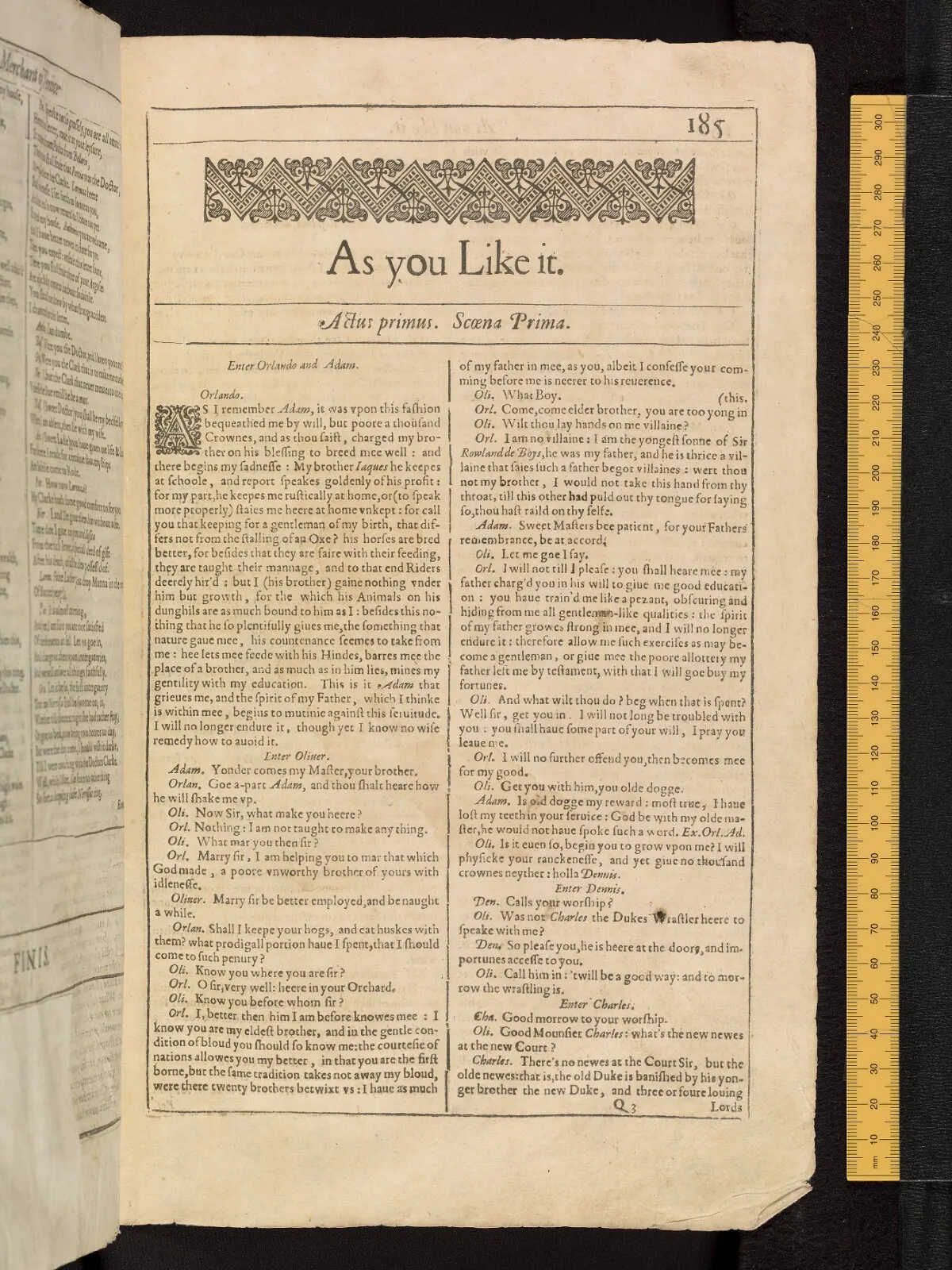
As You Like It. Actus primus. Scœna Prima. [Act 1, Scene 1] Enter Orlando and Adam. Orlando. AS I remember Adam, it was vpon this fashion bequeathed me by will, but poore a thousand Crownes, and as thou saist, charged my bro ther on his blessing to breed mee well: and there begins my sadnesse: My brother Iaques he keepes at schoole, and report speakes goldenly of his profit: for my part, he keepes me rustically at home, or (to speak more properly) staies me heere at home vnkept: for call you that keeping for a gentleman of my birth, that dif fers not from the stalling of an Oxe? his horses are bred better, for besides that they are faire with their feeding, they are taught their mannage, and to that end Riders deerely hir'd: but I (his brother) gaine nothing vnder him but growth, for the which his Animals on his dunghils are as much bound to him as I: besides this no thing that he so plentifully giues me, the something that nature gaue mee, his countenance seemes to take from me: hee lets mee feede with his Hindes, barres mee the place of a brother, and as much as in him lies, mines my gentility with my education. This is it Adam that grieues me, and the spirit of my Father, which I thinke is within mee, begins to mutinie against this seruitude. I will no longer endure it, though yet I know no wise remedy how to auoid it. Enter Oliuer. Adam. Yonder comes my Master, your brother. Orlan. Goe a‑part Adam, and thou shalt heare how he will shake me vp. Oli. Now Sir, what make you heere? Orl. Nothing: I am not taught to make any thing. Oli.
An opening excerpt from the Bodleian transcription, with original spelling retained. Continue in the reader. Text CC BY 3.0.