Antony and CleopatraShakespeare’s First Folio
Scans: Bodleian Libraries, Arch. G c.7.
The First Folio
Bodleian Libraries, University of OxfordThis page image could not load.
This page image could not load.
On the page
Source transcription. Original spelling retained.
Reading Antony and Cleopatra
Tragedies · First Folio, 1623
Antony and Cleopatra moves between political and intimate relationships without allowing them to remain separate. Antony's commitments are judged from Rome and Egypt, while Cleopatra must negotiate the danger of becoming a captive whose image others control. Public accounts of the lovers often compete with what their encounters allow an audience to witness. Read the Folio's changes of scene as changes in perspective: a departure, report, or entrance can alter which version of a character seems persuasive. The struggle extends beyond military victory to the question of who will determine how a life is represented.
Philo's opening speech offers a disapproving interpretation of Antony before Antony and Cleopatra enter. Their arrival lets the audience compare that judgment with a visible encounter. The scene establishes a recurring demand on spectators: distinguish what is shown from the account another character insists it confirms.
Context: Antony and Cleopatra at the Folger Shakespeare Library. Scans and transcription: Bodleian Libraries, Arch. G c.7.
On the opening page
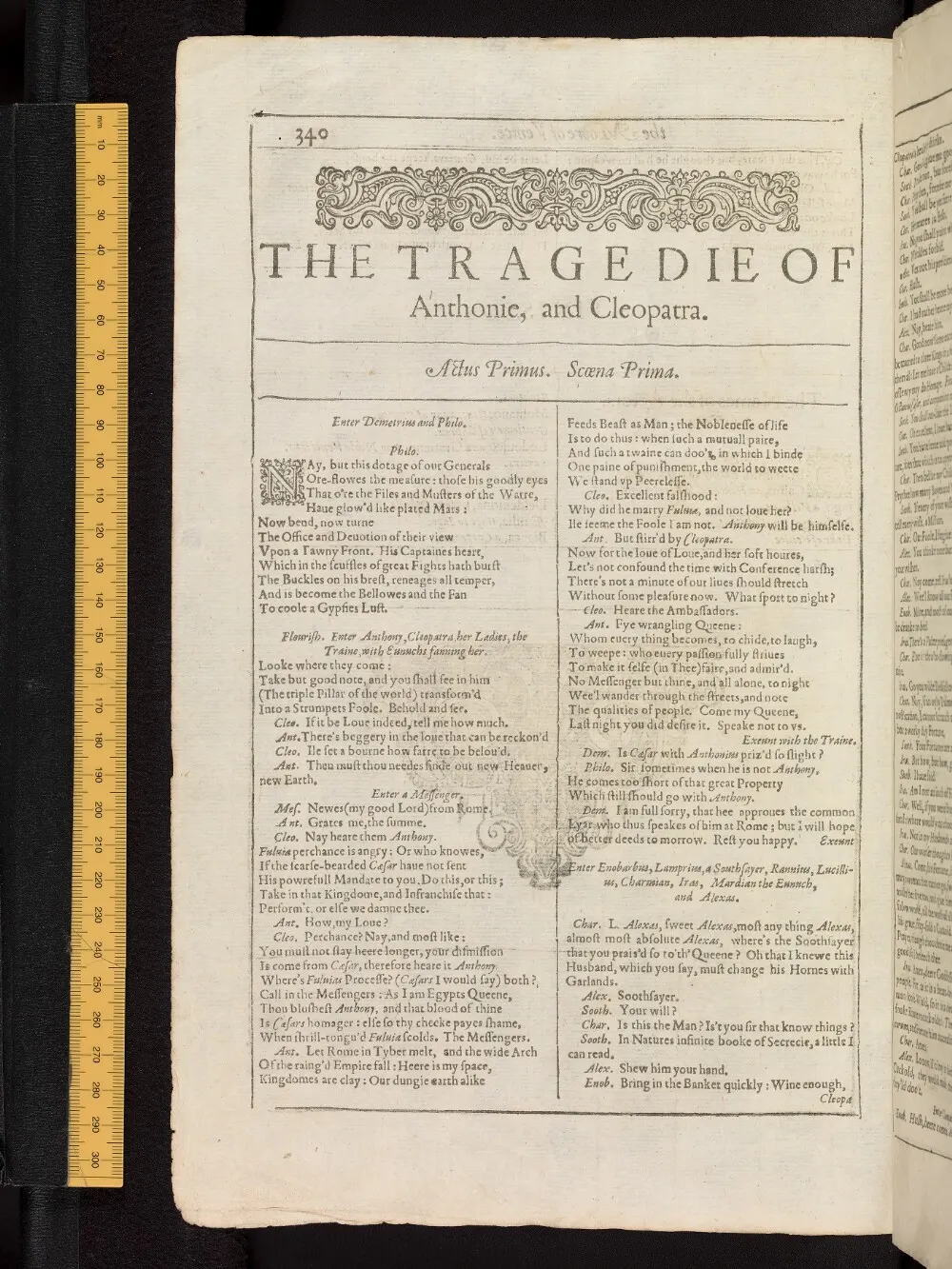
THE TRAGEDIE OF
Anthonie, and Cleopatra.

Actus Primus. Scœna Prima.

[Act 1, Scene 1]

Enter Demetrius and Philo.

Philo.

NAy, but this dotage of our Generals

Ore‑flowes the measure: those his goodly eyes

That o're the Files and Musters of the Warre,

Haue glow'd like plated Mars:

Now bend, now turne

The Office and Deuotion of their view

Vpon a Tawny Front. His Captaines heart,

Which in the scuffles of great Fights hath burst

The Buckles on his brest, reneages all temper,

And is become the Bellowes and the Fan

To coole a Gypsies Lust.

Flourish. Enter Anthony, Cleopatra, her Ladies, the
Traine, with Eunuchs fanning her.

Looke where they come:

Take but good note, and you shall see in him

(The triple Pillar of the world) transform'd

Into a Strumpets Foole. Behold and see.

Cleo.

If it be Loue indeed, tell me how much.

Ant.

There's beggery in the loue that can be reckon'd

Cleo.

Ile set a bourne how farre to be belou'd.

Ant.

Then must thou needes finde out new Heauen,
new Earth.

Enter a Messenger.

Mes.

Newes (my good Lord) from Rome.

Ant.

Grates me, the summe.

Cleo.

Nay heare them Anthony.

Fuluia perchance is angry: Or who knowes,

If the scarse‑bearded Cæsar haue not sent

His powrefull Mandate to you. Do this, or this;

Take in that Kingdome, and Infranchise that:

Perform't, or else we damne thee.

Ant.

How, my Loue?

Cleo.

Perchance? Nay, and most like:

You must not stay heere longer, your dismission

Is come from Cæsar, therefore heare it Anthony

Where's Fuluias Processe? (Cæsars I would say) both?
An opening excerpt from the Bodleian transcription, with original spelling retained. Continue in the reader. Text CC BY 3.0.