All's Well That Ends WellShakespeare’s First Folio
Scans: Bodleian Libraries, Arch. G c.7.
The First Folio
Bodleian Libraries, University of OxfordThis page image could not load.
This page image could not load.
On the page
Source transcription. Original spelling retained.
Reading All's Well That Ends Well
Comedies · First Folio, 1623
All's Well That Ends Well follows Helena's attempt to secure a marriage to Bertram, whose social position exceeds her own. Her ability to cure the King creates an opening that courtly rank would otherwise deny her. Marriage, however, does not produce mutual desire, and Helena must negotiate the conditions Bertram sets for acknowledging her. The Folio places this work among the comedies, but its title should remain a proposition to examine. Follow the distinctions between achieving an outcome, satisfying a condition, and obtaining another person's willing recognition. The play makes those differences difficult to dismiss.
The first entrance brings Bertram, his mother, Helena, and Lafew onstage in mourning clothes. Their talk links the loss of fathers with the King's illness and Bertram's new obligations. The opening establishes bodies in need of care alongside a social order that determines who must serve whom.
Context: All's Well That Ends Well at the Folger Shakespeare Library. Scans and transcription: Bodleian Libraries, Arch. G c.7.
On the opening page
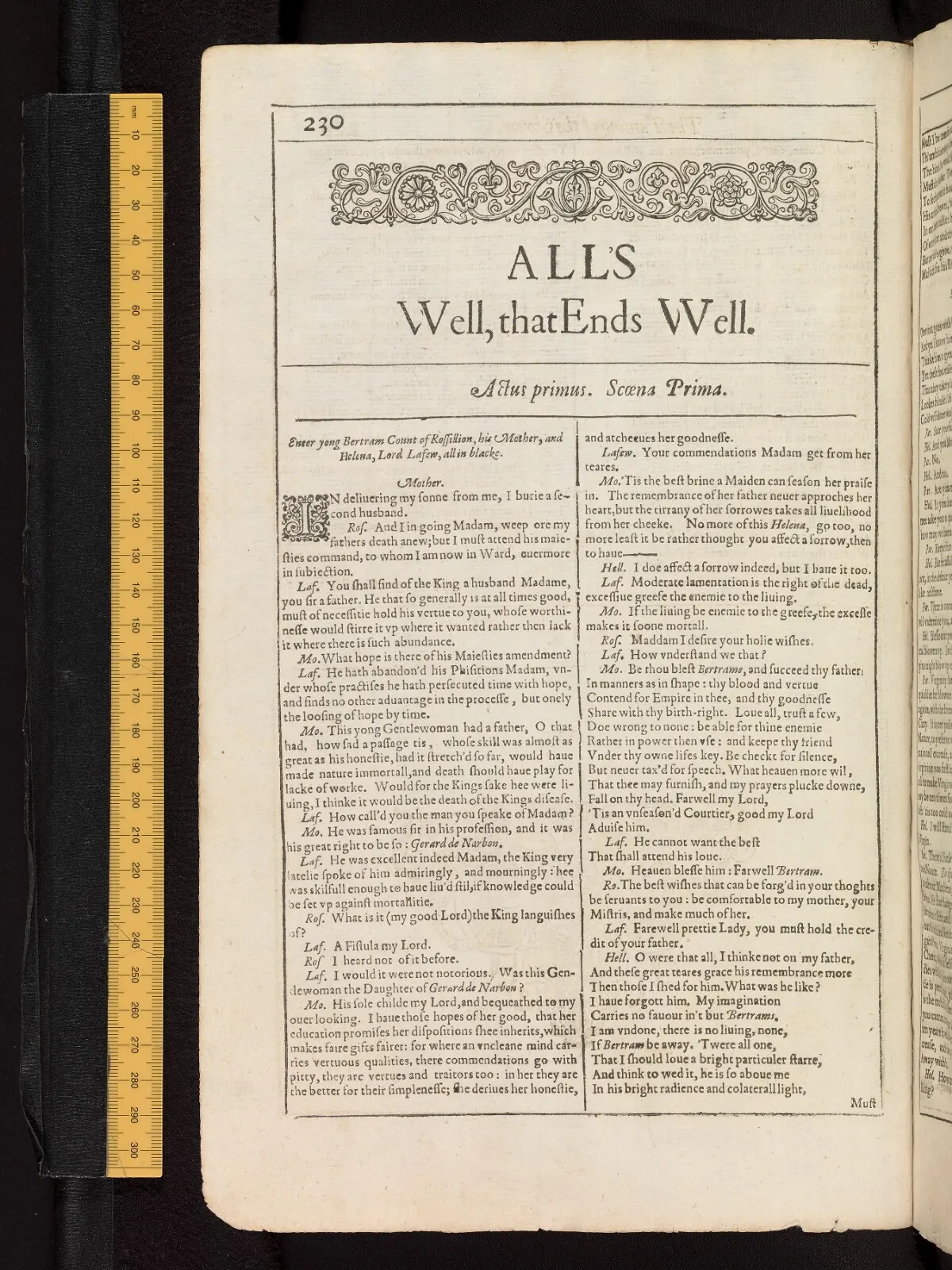
ALL'S Well, that Ends Well. Actus primus. Scœna Prima. [Act 1, Scene 1] Enter yong Bertram Count of Rossillion, his Mother, and Helena, Lord Lafew, all in blacke. Mother. In deliuering my sonne from me, I burie a se cond husband. Ros. And I in going Madam, weep ore my fathers death anew; but I must attend his maie sties command, to whom I am now in Ward, euermore in subiection. Laf. You shall find of the King a husband Madame, you sir a father. He that so generally is at all times good, must of necessitie hold his vertue to you, whose worthi nesse would stirre it vp where it wanted rather then lack it where there is such abundance. Mo. What hope is there of his Maiesties amendment? Laf. He hath abandon'd his Phisitions Madam, vn der whose practises he hath persecuted time with hope, and finds no other aduantage in the processe, but onely the loosing of hope by time. Mo. This yong Gentlewoman had a father, O that had, how sad a passage tis, whose skill was almost as great as his honestie, had it stretch'd so far, would haue made nature immortall, and death should haue play for lacke of worke. Would for the Kings sake hee were li uing, I thinke it would be the death of the Kings disease. Laf. How call'd you the man you speake of Madam? Mo. He was famous sir in his profession, and it was his great right to be so: Gerard de Narbon. Laf. He was excellent indeed Madam, the King very latelie spoke of him admiringly, and mourningly: hee was skilfull enough to haue liu'd stil, if knowledge could be set vp against mortallitie. Ros.
An opening excerpt from the Bodleian transcription, with original spelling retained. Continue in the reader. Text CC BY 3.0.