A Midsummer Night's DreamShakespeare’s First Folio
Scans: Bodleian Libraries, Arch. G c.7.
The First Folio
Bodleian Libraries, University of OxfordThis page image could not load.
This page image could not load.
On the page
Source transcription. Original spelling retained.
Reading A Midsummer Night's Dream
Comedies · First Folio, 1623
A Midsummer Night's Dream moves between the authority of Athens and a wood where desire becomes unstable. Lovers pursue one another, fairy rulers quarrel, and a group of artisans prepares a performance for a wedding. These actions meet through bodies made strange and through spectators who interpret what they see. The Folio reader can follow that traffic between making a performance and watching one. Pay particular attention to the artisans' practical questions: their concerns about representing danger, animals, and moonlight expose the work that allows an audience to recognise a fiction.
Theseus and Hippolyta open the play by counting the days before their marriage. Their different responses to waiting are followed by Egeus's demand for control over his daughter's choice. The movement from wedding preparations to a dispute about consent establishes tensions that the wood will rearrange.
Context: A Midsummer Night's Dream at the Folger Shakespeare Library. Scans and transcription: Bodleian Libraries, Arch. G c.7.
On the opening page
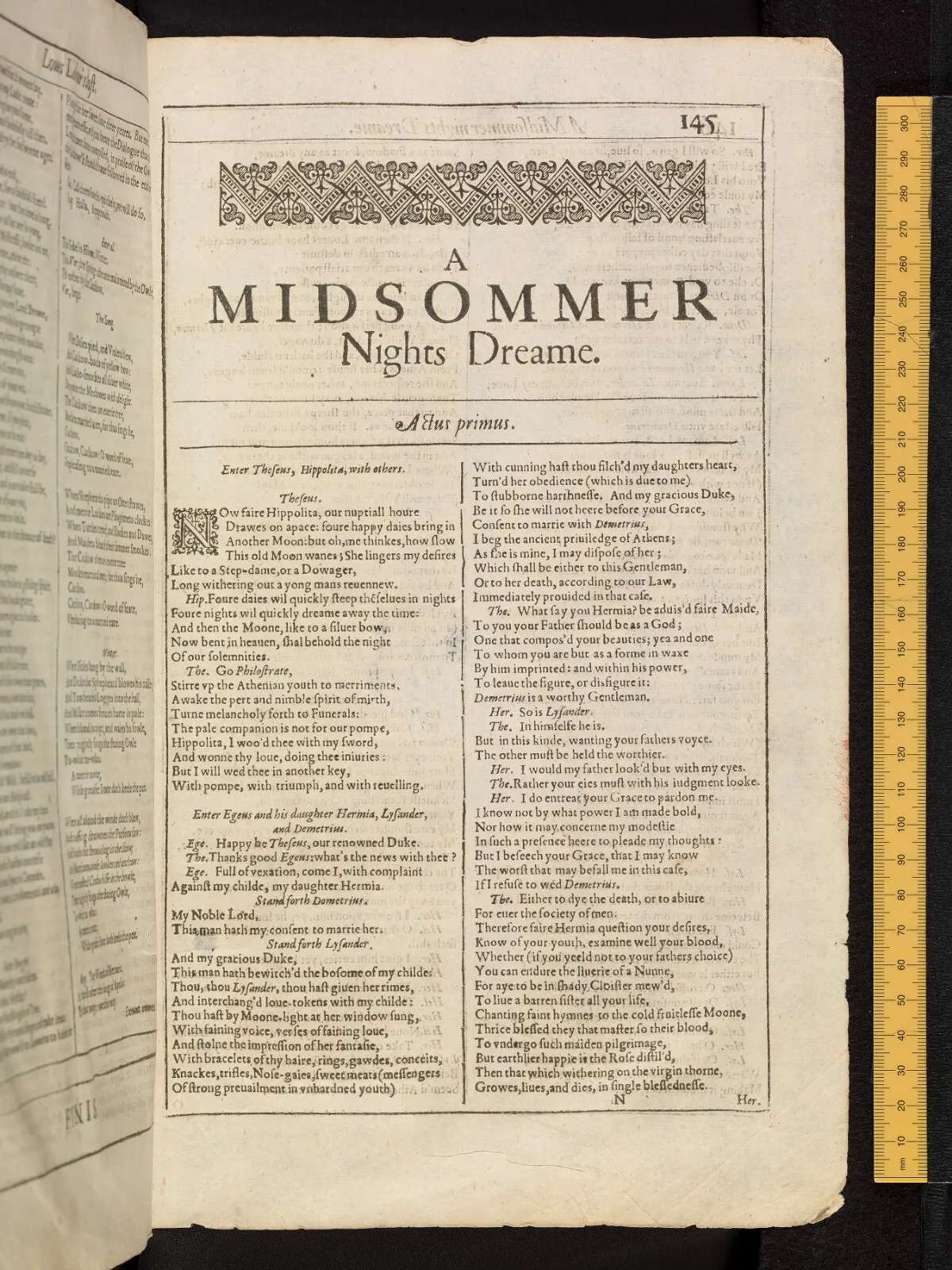
A
MIDSOMMER
Nights Dreame.

Actus primus.

[Act 1, Scene 1]

Enter Theseus, Hippolita, with others.

Theseus.

NOw faire Hippolita, our nuptiall houre

Drawes on apace: foure happy daies bring in

Another Moon: but oh, me thinkes, how slow

This old Moon wanes; She lingers my desires

Like to a Step‑dame, or a Dowager,

Long withering out a yong mans reuennew.

Hip.

Foure daies wil quickly steep theēselues in nights

Foure nights wil quickly dreame away the time:

And then the Moone, like to a siluer bow,

Now bent in heauen, shal behold the night

Of our solemnities.

The.

Go Philostrate,

Stirre vp the Athenian youth to merriments,

Awake the pert and nimble spirit of mirth,

Turne melancholy forth to Funerals:

The pale companion is not for our pompe,

Hippolita, I woo'd thee with my sword,

And wonne thy loue, doing thee iniuries:

But I will wed thee in another key,

With pompe, with triumph, and with reuelling.

Enter Egeus and his daughter Hermia, Lysander,
and Demetrius.

Ege.

Happy be Theseus, our renowned Duke.

The.

Thanks good Egeus: what's the news with thee?

Ege.

Full of vexation, come I, with complaint

Against my childe, my daughter Hermia.

Stand forth Dometrius.

My Noble Lord,

This man hath my consent to marrie her.

Stand forth Lysander.

And my gracious Duke,

This man hath bewitch'd the bosome of my childe:

Thou, thou Lysander, thou hast giuen her rimes,

And interchang'd loue‑tokens with my childe:

Thou hast by Moone‑light at her window sung,

With faining voice, verses of faining loue,

And stolne the impression of her fantasie,
An opening excerpt from the Bodleian transcription, with original spelling retained. Continue in the reader. Text CC BY 3.0.