Richard IIIShakespeare’s First Folio
Scans: Bodleian Libraries, Arch. G c.7.
The First Folio
Bodleian Libraries, University of OxfordThis page image could not load.
This page image could not load.
On the page
Source transcription. Original spelling retained.
Reading Richard III
Histories · First Folio, 1623
Richard III gives its central figure unusual access to the audience as he works toward the crown. Richard explains schemes that other characters cannot hear and then performs different intentions in their presence. That arrangement makes spectators knowledgeable without making them able to intervene. In the Folio, follow the shifts between solitary speech, public ceremony, and conversations whose participants hold unequal information. Richard's success depends on more than a talent for deception; it also depends on people who cooperate, accommodate, or discover too late that a promise no longer protects them.
Richard enters alone and begins by describing the Yorkist peace before separating himself from its pleasures. The speech turns a public account of victory into a private announcement of intention. Read the movement carefully: the audience is being recruited as a listener before Richard addresses anyone else onstage.
Context: Richard III at the Folger Shakespeare Library. Scans and transcription: Bodleian Libraries, Arch. G c.7.
On the opening page
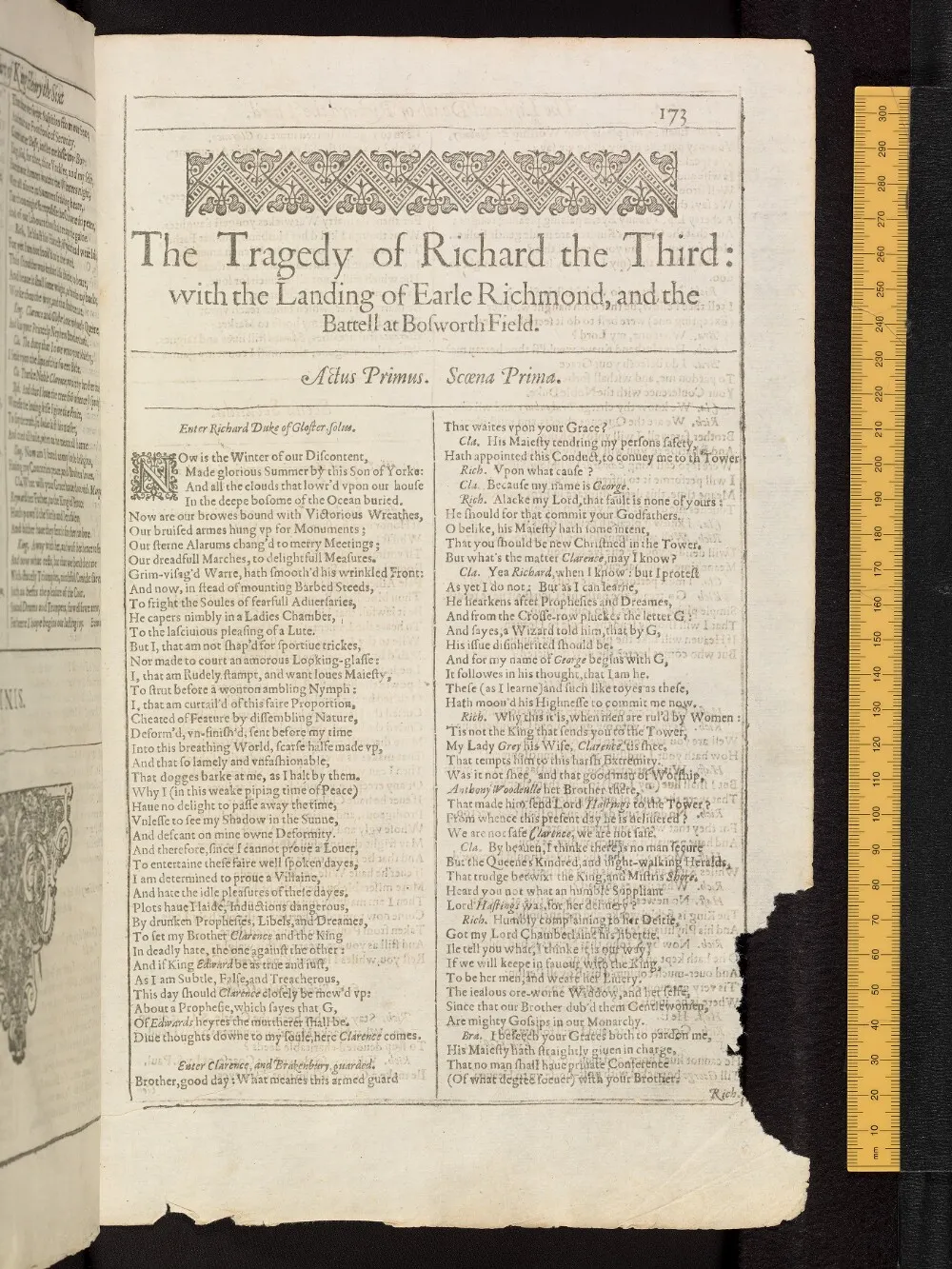
The Tragedy of Richard the Third:
with the Landing of Earle Richmond, and the
Battell at Bosworth field.

Actus Primus. Scœna Prima.

[Act 1, Scene 1]

Enter Richard Duke of Gloster, solus.

NOw is the Winter of our Discontent,

Made glorious Summer by this Son of Yorke:

And all the clouds that lowr'd vpon our house

In the deepe bosome of the Ocean buried.

Now are our browes bound with Victorious Wreathes,

Our bruised armes hung vp for Monuments;

Our sterne Alarums chang'd to merry Meetings;

Our dreadfull Marches, to delightfull Measures.

Grim‑visag'd Warre, hath smooth'd his wrinkled Front:

And now, in stead of mounting Barbed Steeds,

To fright the Soules of fearfull Aduersaries,

He capers nimbly in a Ladies Chamber,

To the lasciuious pleasing of a Lute.

But I, that am not shap'd for sportiue trickes,

Nor made to court an amorous Looking‑glasse:

I, that am Rudely stampt, and want loues Maiesty,

To strut before a wonton ambling Nymph:

I, that am curtail'd of this faire Proportion,

Cheated of Feature by dissembling Nature,

Deform'd, vn‑finish'd, sent before my time

Into this breathing World, scarse halfe made vp,

And that so lamely and vnfashionable,

That dogges barke at me, as I halt by them.

Why I (in this weake piping time of Peace)

Haue no delight to passe away the time,

Vnlesse to see my Shadow in the Sunne,

And descant on mine owne Deformity.

And therefore, since I cannot proue a Louer,

To entertaine these faire well spoken dayes,

I am determined to proue a Villaine,

And hate the idle pleasures of these dayes.
An opening excerpt from the Bodleian transcription, with original spelling retained. Continue in the reader. Text CC BY 3.0.