Richard IIShakespeare’s First Folio
Scans: Bodleian Libraries, Arch. G c.7.
The First Folio
Bodleian Libraries, University of OxfordThis page image could not load.
This page image could not load.
On the page
Source transcription. Original spelling retained.
Reading Richard II
Histories · First Folio, 1623
Richard II follows a king whose inherited authority does not protect him from the consequences of his decisions. Bolingbroke's return makes the relation between legal title and effective power increasingly unstable. Richard can command the language of kingship even as others acquire control over his movements and possessions. Reading the play in the Folio encourages attention to public gestures as well as speeches: accusations are delivered before witnesses, challenges are staged, and the crown becomes an object that can pass between hands. Consider what each ceremony accomplishes and what it leaves unresolved.
Richard opens by arranging to hear Bolingbroke's accusation against Mowbray. He presents himself as the person who can distinguish an injury to the state from a private grievance. The scene offers an early test of that authority through formal speech, competing testimony, and the demand for a public answer.
Context: Richard II at the Folger Shakespeare Library. Scans and transcription: Bodleian Libraries, Arch. G c.7.
On the opening page
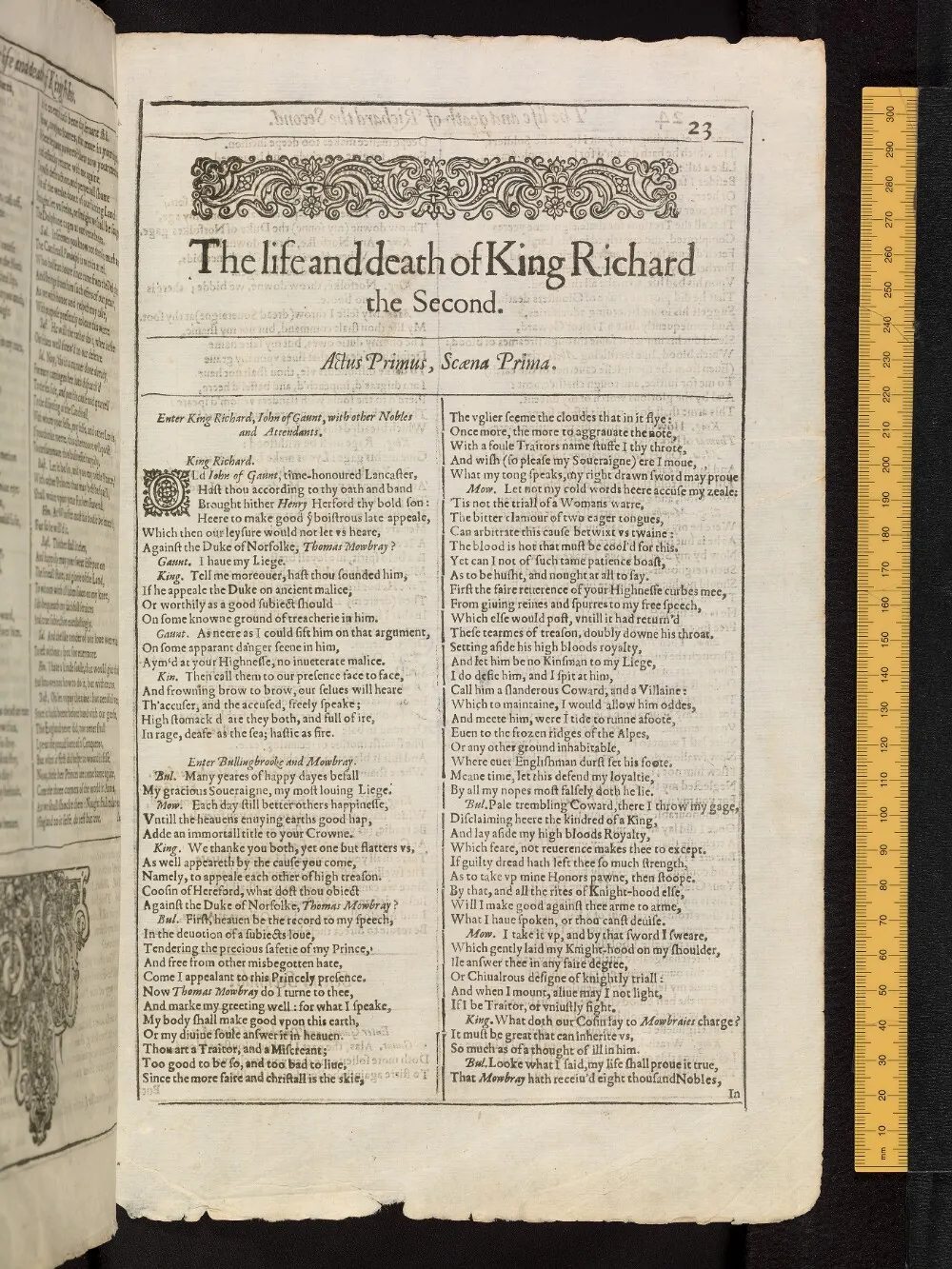
The life and death of King Richard
the Second.

Actus Primus, Scæna Prima.

[Act 1, Scene 1]

Enter King Richard, Iohn of Gaunt, with other Nobles
and Attendants.

King Richard.

OLd Iohn of Gaunt, time‑honoured Lancaster,

Hast thou according to thy oath and band

Brought hither Henry Herford thy bold son:

Heere to make good yͤ boistrous late appeale,

Which then our leysure would not let vs heare,

Against the Duke of Norfolke, Thomas Mowbray?

Gaunt.

I haue my Liege.

King.

Tell me moreouer, hast thou sounded him,

If he appeale the Duke on ancient malice,

Or worthily as a good subiect should

On some knowne ground of treacherie in him.

Gaunt.

As neere as I could sift him on that argument,

On some apparant danger seene in him,

Aym,d at your Highnesse, no inueterate malice.

Kin.

Then call them to our presence face to face,

And frowning brow to brow, our selues will heare

Th'accuser, and the accused, freely speake;

High stomack d are they both, and full of ire,

In rage, deafe as the sea; hastie as fire.

Enter Bullingbrooke and Mowbray.

Bul.

Many yeares of happy dayes befall

My gracious Soueraigne, my most louing Liege.

Mow.

Each day still better others happinesse,

Vntill the heauens enuying earths good hap,

Adde an immortall title to your Crowne.

King.

We thanke you both, yet one but flatters vs,

As well appeareth by the cause you come,

Namely, to appeale each other of high treason.

Coosin of Hereford, what dost thou obiect

Against the Duke of Norfolke, Thomas Mowbray?

Bul.

First, heauen be the record to my speech,
An opening excerpt from the Bodleian transcription, with original spelling retained. Continue in the reader. Text CC BY 3.0.