Henry IV, Part 2Shakespeare’s First Folio
Scans: Bodleian Libraries, Arch. G c.7.
The First Folio
Bodleian Libraries, University of OxfordThis page image could not load.
This page image could not load.
On the page
Source transcription. Original spelling retained.
Reading Henry IV, Part 2
Histories · First Folio, 1623
Henry IV, Part 2 returns to a kingdom where rebellion has outlasted a victory and the King's failing health makes succession urgent. Falstaff continues to use language and social connections to his advantage, but his expectations depend on the future position of Prince Hal. The play repeatedly asks what people know, what they have merely heard, and what they choose to believe. Its opening personification of Rumour makes that problem explicit. Follow the distance between public reports and private encounters, especially as Hal's movement toward kingship changes the meaning of his earlier relationships.
The Folio begins with an Induction spoken by Rumour, before the first ordinary scene. Rumour describes the circulation of false reports and then addresses news of Shrewsbury. Starting here matters: the audience is warned about unreliable information before watching characters act on what has reached them.
Context: Henry IV, Part 2 at the Folger Shakespeare Library. Scans and transcription: Bodleian Libraries, Arch. G c.7.
On the opening page
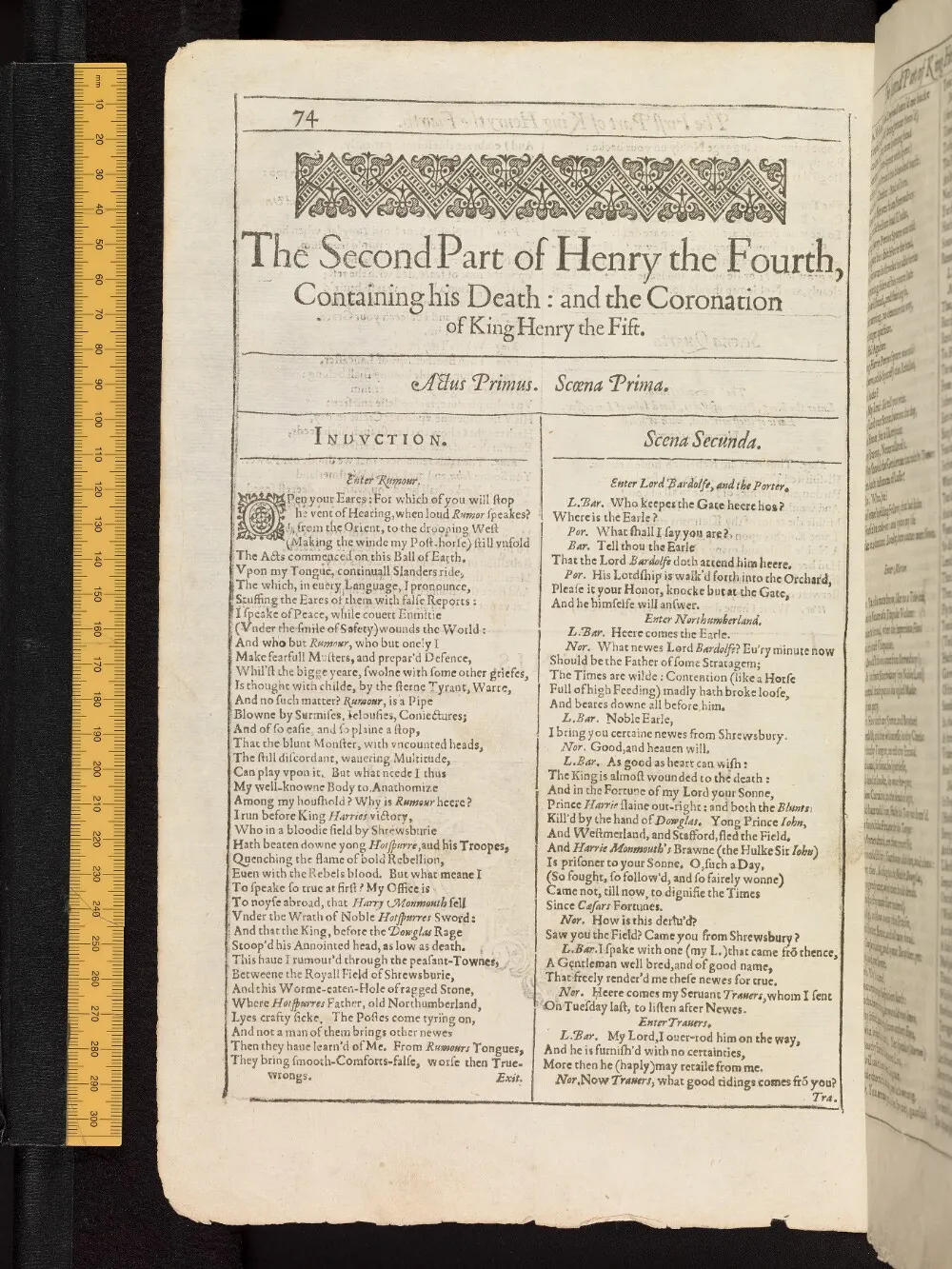
The Second Part of the Henry the Fourth,
Contaning his Death: and the Coronation
of King Henry the Fift.

Actus Primus. Scœna Prima.

[Induction]

INDVCTION.

Enter Rumour.

OPen your Eares: For which of you will stop

[gap]he vent of hearing, when loud Rumour speakes?

[gap] from the Orient, to the drooping West

(Making the wind my Post‑horse) still vnfold

The Acts commenced on this Ball of Earth.

Vpon my Tongue, continuall Slanders ride,

The which, in every Language, I pronounce,

Stuffing the Eares of them with false Reports:

I speak of Peace, while couert Enmitie

(Vnder the smile of Safety) wounds the World:

And who but Rumour, who but onely I

Make fearfull Musters, and prepar'd Defence,

Whil'st the bigge yeare, swolne with some other griefes,

Is thought with childe, by the sterne Tyrant, Warre,

And no such matter? Rumour, is a Pipe

Blown by Surmises, Iealousies, Coniectures;

And of so easie, and so plaine a stop,

That the blunt Monster, with vncounted heads,

The still discordant, wauering Multitude,

Can play vpon it. But what need I thus

My well‑knowne Body to Anatomize

Among my houshold? Why is Rumour heere?

I run before King Harries victory,

Who in a bloodie field by Shrewsburie,

Hath beaten downe young Hotspurre, and his Troopes,

Quenching the flame of bold Rebellion,

Euen with the Rebels blood. But what meane I

To speak so true at first? My Office is

To noyse abroad, that Harry Monmouth fell

Vnder the Wrath of Noble Hotspurres Sword:

And that the King, before the Dowglas Rage

Stoop'd his Anointed head, as low as death.
An opening excerpt from the Bodleian transcription, with original spelling retained. Continue in the reader. Text CC BY 3.0.