Henry VI, Part 1Shakespeare’s First Folio
Scans: Bodleian Libraries, Arch. G c.7.
The First Folio
Bodleian Libraries, University of OxfordThis page image could not load.
This page image could not load.
On the page
Source transcription. Original spelling retained.
Reading Henry VI, Part 1
Histories · First Folio, 1623
Henry VI, Part 1 begins in the shadow of Henry V and follows an English campaign in France strained by rivalry at home. Talbot's military reputation and Joan la Pucelle's authority offer competing images of leadership, while quarrelling nobles weaken the cause they claim to serve. The play's hostile representation of the French should be examined as dramatic and national rhetoric, not accepted as a neutral historical account. In the Folio, watch how battlefield reports, challenges, and acts of public commemoration construct a heroic name even when those who invoke it cannot agree on what to do.
A funeral procession for Henry V opens the play, accompanied by a dead march. The nobles praise the dead king before messengers bring news that strains those celebrations of national strength. The contrast between ceremonial unity and accumulating divisions supplies a practical starting point for reading the history.
Context: Henry VI, Part 1 at the Folger Shakespeare Library. Scans and transcription: Bodleian Libraries, Arch. G c.7.
On the opening page
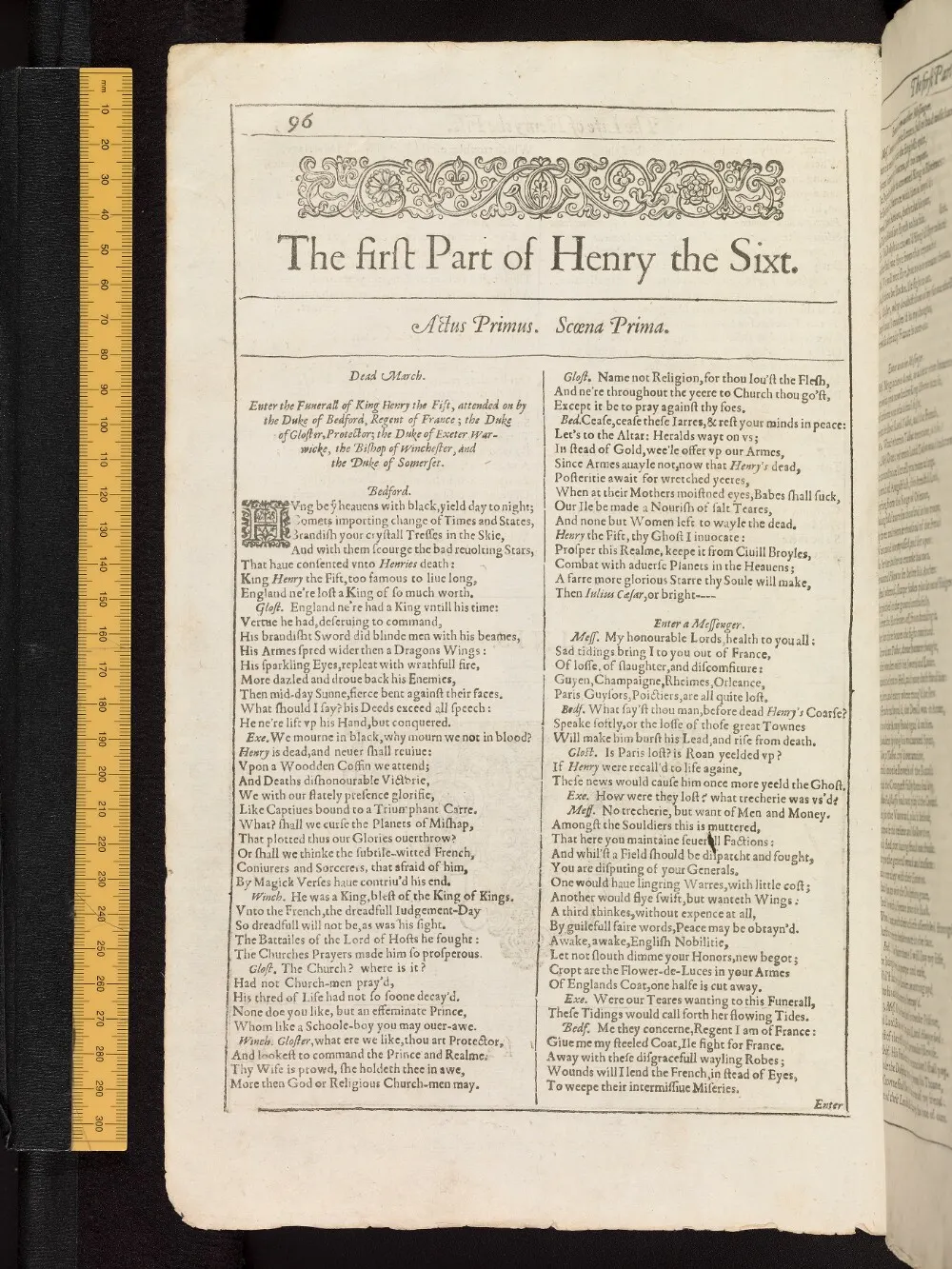
The first Part of Henry the Sixt Actus Primus. Scœna Prima. [Act 1, Scene 1] Dead March. Enter the Funerall of King Henry the Fift, attended on by the Duke of Bedford, Regent of France; the Duke of Gloster, Protector; the Duke of Exeter War wicke, the Bishop of Winchester, and the Duke of Somerset. Bedford. HVng be yͤ heauens with black, yield day to night; Comets importing change of Times and States, Brandish your crystall Tresses in the Skie, And with them scourge the bad reuolting Stars, That haue consented vnto Henries death: King Henry the fift, too famous to liue long, England ne're lost a King of so much worth. Glost. England ne're had a King vntill his time: Vertue he had, deseruing to command, His brandisht Sword did blinde men with his beames, His Armes spred wider then a Dragons Wings: His sparkling Eyes, repleat with wrathfull fire, More dazled and droue back his Enemies, Then mid‑day Sunne, fierce bent against their faces. What should I say? his Deeds exceed all speech: He ne're lift vp his Hand, but conquered. Exe. We mourne in black, why mourn we not in blood? Henry is dead, and neuer shall reuiue: Vpon a Woodden Coffin we attend; And Deaths dishonourable Victorie, We with our stately presence glorifie, Like Captiues bound to a Triumphant Carre. What? shall we curse the Planets of Mishap, That plotted thus our Glories ouerthrow? Or shall we thinke the subtile‑witted French, Coniurers and Sorcerers, that afraid of him, By Magick Verses haue contriu'd his end. Winch. He was a King, blest of the King of Kings.
An opening excerpt from the Bodleian transcription, with original spelling retained. Continue in the reader. Text CC BY 3.0.