Henry VShakespeare’s First Folio
Scans: Bodleian Libraries, Arch. G c.7.
The First Folio
Bodleian Libraries, University of OxfordThis page image could not load.
This page image could not load.
On the page
Source transcription. Original spelling retained.
Reading Henry V
Histories · First Folio, 1623
Henry V asks its audience to imagine armies and journeys that a stage cannot literally contain. The Chorus invites that imaginative work, while the scenes that follow give different accounts of what war demands. Henry's public speeches coexist with the perspectives of soldiers and with disputes over responsibility for their deaths. Read those voices together rather than treating any one as the play's complete judgment. The Folio's prologues and scene divisions make it possible to compare the story promised to spectators with the encounters that complicate it, from the preparations for France to the aftermath of Agincourt.
The opening speaker directly addresses the audience's ability to supply what the theatre lacks. Horses, armies, and two kingdoms must be imagined within a small playing space. The request makes the reader a participant in representation before the political case for the French campaign is presented.
Context: Henry V at the Folger Shakespeare Library. Scans and transcription: Bodleian Libraries, Arch. G c.7.
On the opening page
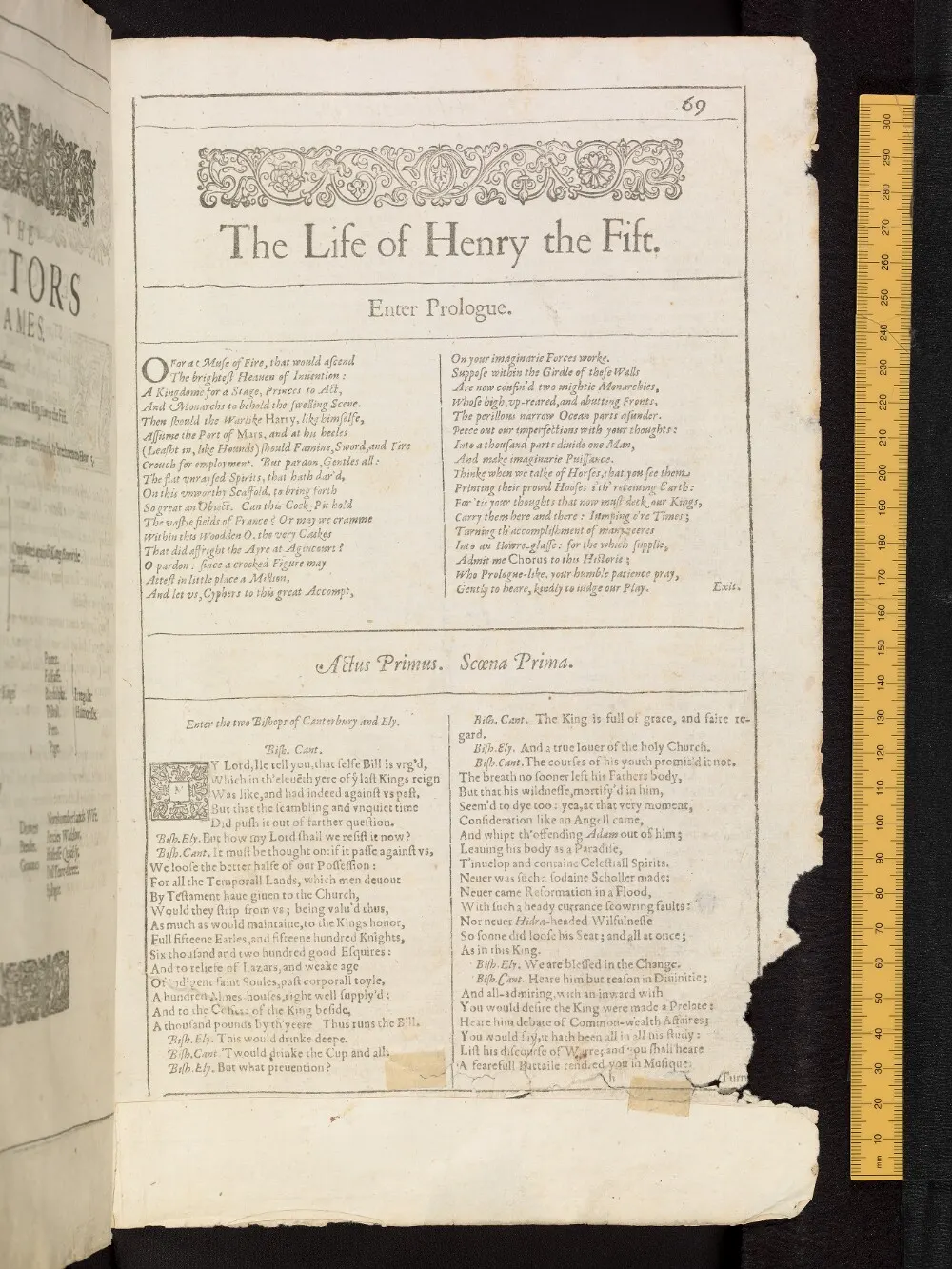
The Life of Henry the Fift.

[Prologue]

Enter Prologue.

O For a Muse of Fire, that would ascend

The brightest Heauen of Inuention:

A Kingdome for a Stage, Princes to Act,

And Monarchs to behold the swelling Scene.

Then should the Warlike Harry, like himselfe,

Assume the Port of Mars, and at his heeles

(Leasht in, like Hounds) should Famine, Sword, and Fire

Crouch for employment. But pardon, Gentles all:

The flat vnraysed Spirits, that hath dar'd,

On this vnworthy Scaffold, to bring forth

So great an Obiect Can this Cock-Pit hold

The vastie fields of France? Or may we cramme

Within this Woodden O. the very Caskes

That did affright the Ayre at Agincourt?

O pardon: since a crooked Figure may

Attest in little place a Million,

And let vs, Cyphers to this great Accompt,

On your imaginarie Forces worke.

Suppose within the Girdle of these Walls

Are now confin'd two mightie Monarchies,

Whose high, vp-reared, and abutting Fronts,

The perillous narrow Ocean parts asunder.

Peece out our imperfections with your thoughts:

Into a thousand parts diuide one Man,

And make imaginarie Puissance.

Thinke when we talke of Horses, that you see them

Printing their prowd Hoofes i'th' receiuing Earth:

For 'tis your thoughts that now must deck our Kings,

Carry them here and there: Iumping o're Times;

Turning th'accomplishment of many yeeres

Into an Howre-glasse: for the which supplie

Admit me Chorus to this Historie;

Who Prologue-like, your humble patience pray,

Gently to heare, kindly to iudge our Play.

Exit.

Actus Primus. Scœna Prima

[Act 1, Scene 1]
An opening excerpt from the Bodleian transcription, with original spelling retained. Continue in the reader. Text CC BY 3.0.